
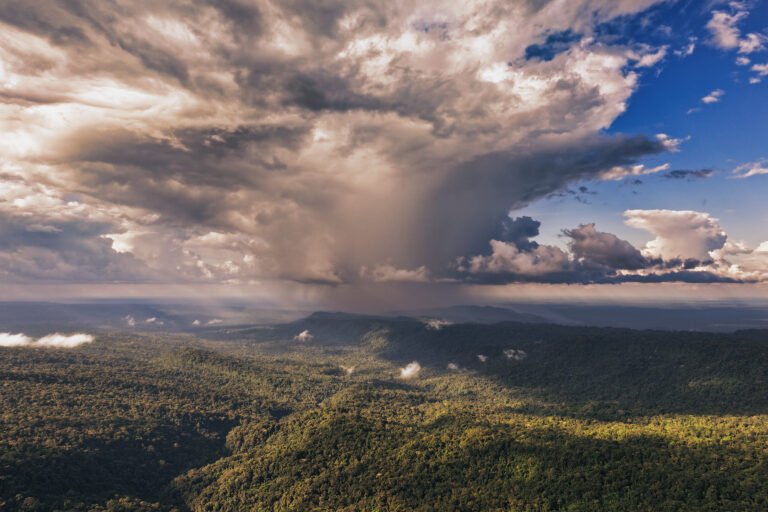
Forests as Rainmakers (Image Credits: Imgs.mongabay.com)
The Amazon – Vast forests in this region do more than harbor biodiversity; they actively produce and distribute rainfall essential to distant lands.
Forests as Rainmakers
Researchers have uncovered a striking truth: tropical forests like those in the Amazon generate their own rain. Evaporation from leaves releases enormous amounts of water vapor into the atmosphere. This process, known as transpiration, creates clouds that later release precipitation not just locally but far beyond the forest canopy.
Unlike traditional views that attribute rain solely to ocean evaporation and wind patterns, these ecosystems play a pivotal role. Trees recycle moisture through a continuous cycle. They draw water from the soil, release it skyward, and foster conditions for storms to form. This mechanism challenges long-held assumptions about tropical weather.
The Mechanism of Moisture Transport
Winds carry the water-laden air masses eastward and southward from the Amazon. These aerial rivers deliver moisture to agricultural heartlands in southern Brazil, Paraguay, and even Argentina. Without this influx, droughts would intensify in those areas.
Scientists describe this as a feedback loop. Healthy forests sustain high humidity levels. They regulate temperature and airflow, ensuring steady rain distribution. Disruptions in one area ripple outward, affecting entire continents.
Conservation at Stake
Protecting these forests emerges as critical for global water security. Deforestation severs the cycle, reducing moisture output. Logged areas produce less vapor, leading to drier conditions downstream.
Efforts to curb illegal logging and promote reforestation gain urgency. International agreements highlight the Amazon’s role in climate stability. Policymakers increasingly recognize that preserving trees equates to safeguarding rain.
Key Processes in Rain Generation
The interplay involves several interconnected steps:
- Roots absorb groundwater, fueling tree growth.
- Leaves transpire water, adding billions of tons of vapor annually.
- Clouds form from the humid air, triggered by forest-induced cooling.
- Trade winds propel the moisture toward populated regions.
- Precipitation falls, replenishing soils and rivers far from the source.
This list underscores the forest’s efficiency as a natural rain factory.
Key Takeaways
- Tropical forests actively create rain through transpiration.
- Amazon moisture supports agriculture across South America.
- Deforestation threatens this vital export, risking widespread droughts.
The Amazon stands as a powerhouse of hydrological generosity, exporting rain that underpins economies and ecosystems alike. As pressures mount from development, the need for concerted conservation grows ever clearer. What steps should nations take to protect this natural wonder? Share your thoughts in the comments.


