

You already know your dog is special. You see it in the way they greet you at the door, the way they curl up beside you on a rough day, or how they somehow always know when something is wrong. But here’s the thing – what you’ve witnessed so far might just be scratching the surface.
Your dog is, quite literally, a biological marvel. Science has been catching up to what dog lovers have long suspected, and the findings are genuinely jaw-dropping. From detecting diseases no machine can find to navigating the planet using Earth’s own magnetic field, your four-legged companion carries abilities that border on the extraordinary. Get ready to look at your pup through completely new eyes. Let’s dive in.
1. A Nose That Can Literally Save Your Life

A dog’s sense of smell is legendary, surpassing human capabilities by orders of magnitude. Their nasal cavity houses approximately 300 million olfactory receptors, compared to our mere six million. Think of it like this: if smell were music, humans are playing a kazoo while dogs are conducting a full symphony orchestra.
Their powerful noses allow them to detect odors at concentrations of one part per trillion. In one study, when trained to detect a specific odor, dogs were able to find it at concentrations 1,000 to 1,000,000 times lower than humans. That means your dog sniffing the corner of the couch isn’t being weird. He’s reading an entire novel you can’t even see.
2. They Can Smell Disease Before Doctors Can Detect It

Research suggests that dogs can detect many types of cancers in humans. Like many other diseases, cancers leave specific traces, or odor signatures, in a person’s body and bodily secretions. Cancer cells, or healthy cells affected by cancer, produce and release these odor signatures. This isn’t science fiction. This is happening right now in real research labs.
In a pilot study with 200 test samples involving 10 cancer types, presented at the American Society of Clinical Oncology conference, Dognosis dogs detected 96 percent of cancers. With a sense of smell that researchers estimate is between 10,000 and 100,000 times superior to ours, dogs can detect cancer far earlier in the disease’s progress, even while the cancer is still in situ, or has not spread from the site where it was first formed. Honestly, that statistic still gives me chills every time I read it.
3. They Hear a World Completely Invisible to Us
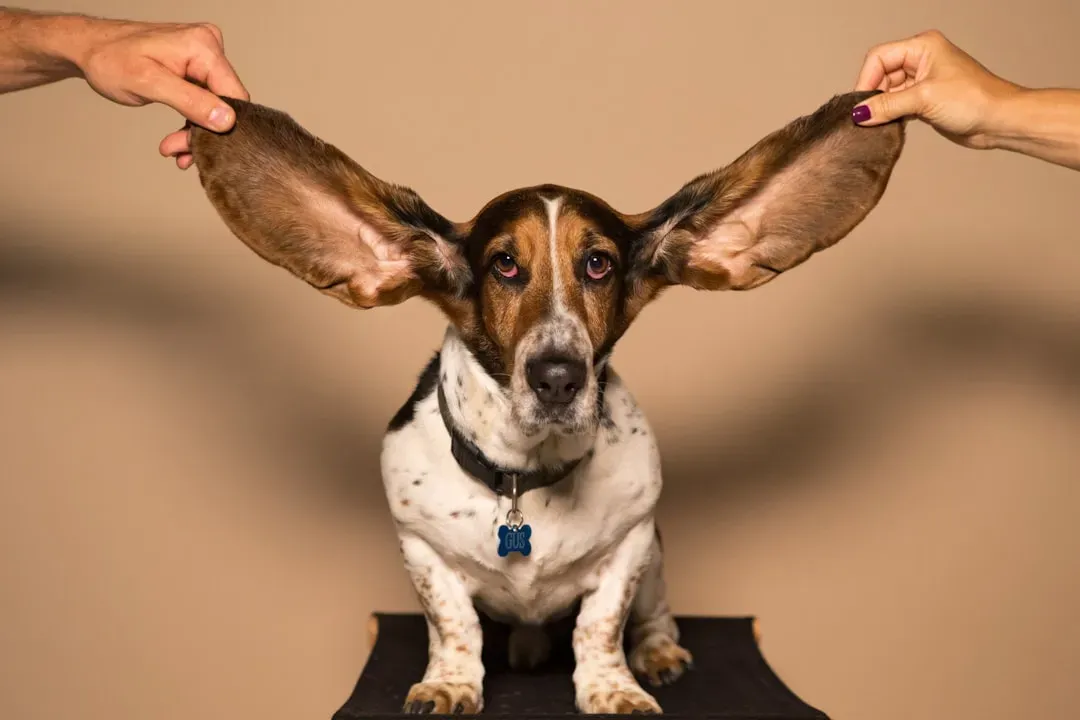
Here’s the one that really floors most people. One impressive canine trait is that dogs can hear at frequencies from about 40 Hz to 60,000 Hz, compared to the human range of 20 Hz to 20,000 Hz. That means your dog is constantly tuned into a sonic world you’ll never experience.
Canine ears are home to some 18 muscles that make it possible for your pooch to tilt, rotate, and wiggle their ears in just the right direction to capture a sound. By way of comparison, the human ear only has six muscles. It’s thought that dogs developed the ability to hear high-frequency sounds so they could determine where those sounds were coming from. So next time your dog’s head snaps toward a blank wall for no apparent reason, they’re probably hearing something very real. Trust them on this.
4. They Can Read Your Emotions Better Than You Think

Dogs are remarkably adept at reading human emotions, interpreting facial expressions, body language, and vocal tones with surprising accuracy. This ability is likely a result of their long history of co-evolution with humans, which has fostered a deep understanding of our social cues. It’s not your imagination when you feel like your dog “just knows.” They genuinely do.
Dogs are excellent at reading human facial expressions. They can tell the difference between happy, angry, and neutral faces, and they respond accordingly. If you come home after a bad day, your dog will likely approach more cautiously. You’ll probably get a tail wag, and a face lick if you’re smiling. They don’t just respond to our actions – they read our emotional cues and adjust their behavior to match. A living, breathing emotional mirror, basically.
5. Their Tail Is Actually Speaking Its Own Language

You’ve always known that a wagging tail means a happy dog, right? Well, it’s far more nuanced than that. Researchers at the University of Trento, Italy, found that happy dogs wag their tails more to the right (from the dog’s point of view), while nervous dogs wag more to the left. Findings also show that dogs recognize and respond to these distinct patterns. It’s basically a whole emotional broadcast system.
Dogs looking at moving video images of other dogs exhibiting prevalent left or right asymmetric tail wagging showed higher cardiac activity and higher scores of anxious behavior when observing left rather than right-biased tail wagging. The finding that dogs are sensitive to the asymmetric tail expressions of other dogs supports the hypothesis of a link between brain asymmetry and social behavior. So the next time you see two dogs sizing each other up, watch their tails closely. They’re having a full conversation.
6. They Can Sense Seizures Before They Happen

This one is quietly miraculous. Seizure-alert dogs can sense an oncoming epileptic episode minutes before it happens, possibly by detecting subtle chemical or behavioral cues. For someone living with epilepsy, that early warning can mean the difference between falling safely to the ground or falling into traffic.
Dogs can smell things that humans couldn’t even fathom. From hormonal changes related to fear, anxiety, and sadness to impending seizures, COVID-19, and blood sugar crashes. Let’s be real, no wearable tech on the market today does all of that. Your dog’s nose is essentially a walking, tail-wagging diagnostic tool, and the science continues to prove it.
7. They May Be Able to Sense Earthquakes Coming

This feels like folklore, but the evidence is strikingly interesting. A recent study of an earthquake in a region of Siberia noted that a small but significant number of dogs showed anxious behaviors, including barking for no reason, howling, whining, and running around, minutes to hours before the earthquake occurred. People dismissed this for generations, but researchers are now taking it seriously.
A study by Dr. Stanley Coren found that some dogs could detect an earthquake, with increased activity and anxiety observed 24 hours prior. Dr. Coren suggests that dogs use their remarkable sense of hearing to pick up high-pitch sounds of rocks scraping beneath the earth, an event that precedes earthquakes. Dogs with pointy ears and smaller head sizes were better at detecting the sound than those with floppy ears and larger heads. It’s hard to say for sure this will ever translate into a reliable early-warning system, but I wouldn’t bet against the dog.
8. They Have a Magnetic Compass Built Into Their Eyes

I know, I know. It sounds wild. Observations of foxes, dogs, and even humans actually indicate that they can perceive the Earth’s magnetic field. Scientists traced this back to a specific light-sensitive molecule found in the retina.
Researchers from the Max Planck Institute for Brain Research in Frankfurt detected cryptochrome 1 in photoreceptors in several mammalian species. It is therefore possible that these animals also have a magnetic sense that is linked to their visual system. Dogs and some primates can sense the Earth’s magnetic field with the help of molecules in their eyes. Think of your dog as a furry, four-legged compass that also loves belly rubs. Navigation and cuddles. The full package.
9. They Experience Genuine Empathy

Empathy is, in fact, a superpower. According to Psychology Today, dogs and puppies not only understand your sentiments, but they can also empathize with you. And this isn’t just owners projecting feelings onto their pets. This is backed by controlled research.
When their owners sobbed, pets would lay on them, nuzzle, lick, or otherwise try to console them. However, the dogs ended up comforting crying strangers too, despite the fact that they had no emotional connection with them, simply because they noticed that they were concerned. Your dog doesn’t comfort you because they expect a treat. They comfort you because something deep in their nature compels them toward the distressed. That’s not a trick. That’s a soul.
10. They Are Masters of Adaptability – Perhaps Their Greatest Superpower of All

Perhaps the most remarkable canine superpower is their adaptability. Dogs have evolved alongside humans, adapting to a wide range of environments and roles. This adaptability has allowed them to thrive in diverse settings, from urban apartments to rural farms. Their ability to learn, adapt, and form strong bonds with humans has made them an indispensable part of our lives.
The bond between dogs and their humans resembles the attachment bond between infants and caregivers. Dogs seek closeness, become distressed when separated, and are comforted by our presence. This attachment is part of what makes dogs such powerful companions – it’s not just loyalty, it’s a deep psychological connection rooted in both biology and love. No other creature on earth has co-evolved with humans so deeply, so willingly, and with such heart.
Conclusion: Your Dog Is More Than You Ever Imagined

Every single day, your dog wakes up and walks through a world overflowing with sounds you’ll never hear, smells you’ll never detect, and emotional signals you’ll never fully read. They navigate all of it, quietly and lovingly, while staying completely devoted to you.
The more science investigates our dogs, the more we realize that the word “superpower” isn’t an exaggeration. It’s barely enough. From sniffing out cancer to feeling the Earth move, from reading your sadness to broadcasting their own joy through the direction of a tail wag, your dog is extraordinary on a level most of us have only just begun to understand.
So next time your dog stares at you with those deep, knowing eyes, maybe ask yourself: who is really taking care of whom? Share this with a fellow dog lover and tell us in the comments – which superpower surprised you the most?


