
Ever wonder what it’s like to experience the world the way your dog does? Your furry friend is navigating an entirely different universe than you are, picking up information from channels you didn’t even know existed. Their world is layered with signals, scents, and sensations that remain invisible to us humans.
Think about it. When your dog suddenly stops on a walk and fixates on something you can’t see or smell, there’s a reason. They’re tapping into hidden sensory superpowers that go far beyond the five senses we’re familiar with. These aren’t just enhanced versions of what we have. These are completely separate systems wired into their biology, ancient tools passed down through evolution.
Let’s pull back the curtain on the remarkable ways your dog experiences reality. You might never look at that curious head tilt or intense sniffing session the same way again.
Magnetoreception: Their Built-In Compass

Dogs may sense Earth’s magnetic field and use it like a compass, helping them calculate shortcuts in unfamiliar terrain. Yes, you read that right. Czech scientists have found evidence that canines can sense and navigate using Earth’s weak magnetic field.
Research found that dogs chasing an animal’s scent began their return with a roughly 20-metre run along a north-south axis, regardless of where their owner was standing. This behavior, called a “compass run,” seems to help them recalibrate their position. Dogs demonstrate magnetic sensitivity and show a measurable behavioral reaction upon natural magnetic field fluctuation.
A molecule called cryptochrome 1a is found in the retina of a dog’s eye and is believed to be activated by Earth’s magnetic fields. It’s the same mechanism birds use during migration. So when your dog poops facing north or south during calm magnetic conditions, they’re not being quirky. They’re aligning themselves with invisible forces we can’t even detect.
Chemosignal Detection: Reading Emotional Scents

Here’s where things get truly fascinating. Dogs exposed to human fear sweat samples spontaneously showed more owner-seeking and higher heart rates than with happiness samples. They’re not just smelling your perfume or last night’s dinner on your hands.
Chemosignals are chemical substances that animals excrete consciously or unconsciously to alter others’ behavior. Think of it as an invisible emotional language broadcast through sweat and breath. Dogs are capable of detecting and distinguishing chemosignals associated with happiness, fear, and a neutral state of being.
Your dog knows when you’re anxious before you even realize it yourself. Research has discovered that dogs can detect odors that indicate changes in stress levels. When you’re feeling down and your pup curls up next to you offering comfort, it’s not coincidence. They’ve literally smelled the shift in your emotional chemistry. That’s why trying to hide fear or anxiety from your dog is basically impossible.
The Vomeronasal Organ: A Second Nose for Pheromones

The vomeronasal organ is an accessory olfactory organ connected directly to a dog’s brain, used to detect and interpret pheromones given off by other animals. Humans don’t have a functional version of this organ, but dogs absolutely do.
The vomeronasal organ, also called Jacobson’s organ, is located in the nasal cavity just above the roof of the mouth. Dogs use this organ to smell pheromones, which are chemical signals given off by other dogs, allowing them to detect whether nearby dogs are happy, in the mood for mating, or scared.
You’ve probably seen your dog curl their lip back and open their mouth while sniffing something intensely. This is called the flehmen response, which allows the organ to be exposed to the air and has a better chance of picking up pheromonal scents. It looks weird, maybe even like a grimace, but they’re actually channeling air directly into this specialized organ for lightning-fast information processing.
Ultrasonic Hearing: The Sounds We’ll Never Hear
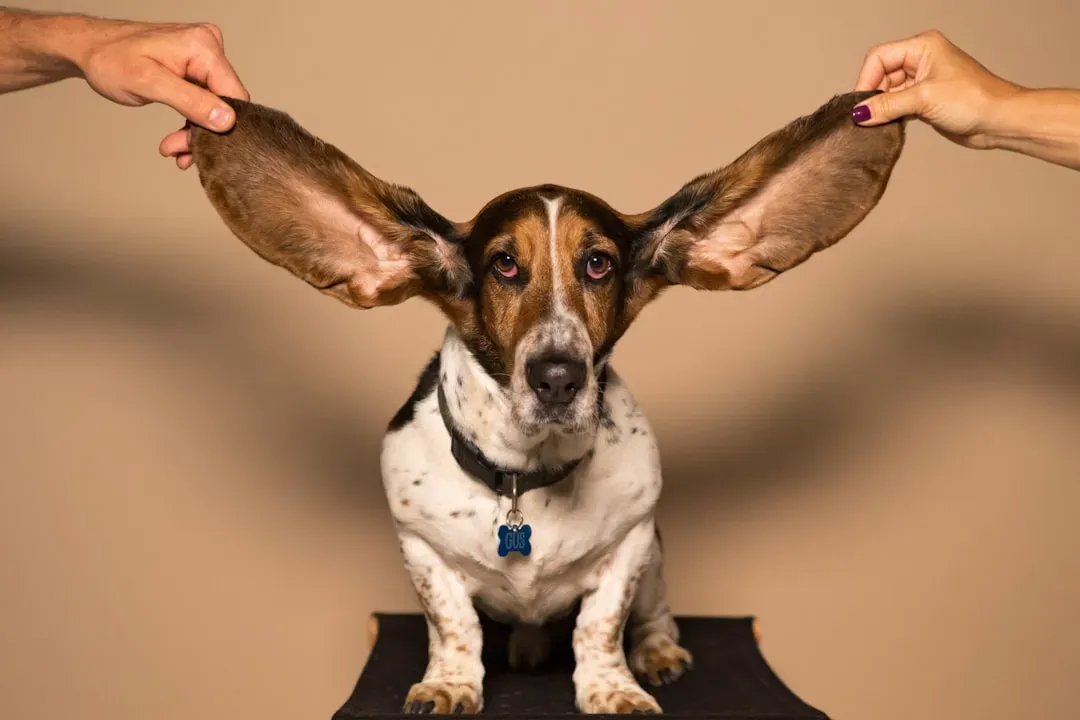
Dogs can hear at frequencies from about 40 Hz to 60,000 Hz, compared to the human range of 20 Hz to 20,000 Hz. That means they’re picking up on entire soundscapes that are completely silent to you. Dogs can hear frequencies between 47,000 and 65,000 hertz, while humans can only detect sounds up to 20,000 hertz.
This specialized sense of hearing helps dogs detect the world’s faintest sounds, such as the high-pitched vocalizations expressed at ultrasonic frequencies in small animals like rodents and bats. When your dog barks at seemingly nothing, they might be reacting to rodents scurrying inside your walls or ultrasonic pest deterrents you installed and forgot about.
This ability goes beyond just hearing higher pitches. Dogs can also hear sounds from much farther away than we can. That’s why they start howling at an ambulance siren long before you hear it approaching. Their ears are tuned to a frequency range that opens up an entirely different acoustic world.
Olfactory Time Perception: Smelling the Passage of Time

This one sounds like science fiction, but it’s real. Dogs use their noses to tell time by monitoring the intensity of a smell; as the day progresses, your smell fades, and dogs can identify the intensity of your lingering smell to determine when you should be arriving home.
The theory of scent distribution and a dog’s ability to remember something based on scent is called olfactory memory, and it’s plausible that a dog can track short amounts of time by the strength of an odor. When you leave for work, you leave behind your scent at a certain intensity. By the time you return eight hours later, that scent has faded to a specific level your dog recognizes.
Think about it. Your dog isn’t checking a clock or counting minutes. Dogs don’t have the ability to count the days while you’re away, but their sense of smell lets them know you’ve been gone a long time because your home smells less like you. It’s like they’re reading a scent calendar that updates in real time. Pretty amazing when you think about how they’ve adapted this superpower to sync with our daily routines.
Seismic Sensitivity: Feeling the Earth Move

Dogs have an uncanny ability to sense earthquakes before they happen, with countless reports of dogs barking, whining, or acting strangely just before an earthquake strikes. This isn’t supernatural. It’s science.
Dogs can hear the movements of rocks underground that happen just before earthquakes. Dogs have been known to detect changes in seismic activity and feel small movements before earthquakes occur. Their ultra-sensitive hearing and ability to detect vibrations give them advance warning of geological events.
Dogs with pricked ears heard the seismic sounds before the earthquake more readily than did dogs with floppy ears. So if your usually calm dog suddenly becomes anxious or clingy for no apparent reason, pay attention. They might be picking up on environmental changes that are completely invisible to you. Some believe they can also sense shifts in barometric pressure and electromagnetic fields related to storms.
Ultraviolet Vision: Seeing Beyond Our Spectrum
A 2014 study found that dogs are equipped with special lenses capable of transmitting significant amounts of UV rays, making them sensitive to ultraviolet light. Dogs can see ultraviolet light!
This means they can pick up on details in the world that are totally hidden to us, like urine trails or specific patterns in nature. UV light detection may have helped dogs hunt down animals by spotting urine trails, as the urine of small rodents is reflective in the ultraviolet range.
Your dog’s world literally has extra colors and visual information you can’t access. When they’re staring intently at what looks like a blank wall to you, they might be seeing UV-reflective patterns or traces invisible to human eyes. This gives them a hunting and navigational advantage, especially in low-light conditions where UV detection becomes even more valuable.
Enhanced Temporal Processing: Experiencing Time Differently

Dogs can process more visual information than we can at a 25% faster rate! This means the world moves in a slightly different speed for them than it does for us. Imagine watching a movie at one and a quarter speed constantly. That’s closer to their reality.
All animals have circadian rhythms, physical and mental changes that follow a 24-hour cycle, and this internal mechanism controlling regular activities is often called our biological clock. A dog’s circadian rhythm works similarly to a person’s circadian rhythms, and experts believe canine cycles adapted to human cycles during domestication.
But here’s the thing. Dogs experience time through a combination of pattern recognition, environmental cues, and that incredible sense of smell we talked about earlier. A dog’s concept of time revolves around routine, daily patterns, and associative learning; they can’t understand time in the abstract sense of hours and minutes, but they do have an internal awareness of time intervals. That’s why disrupting their routine can be so stressful for them. They’re not just creatures of habit; their entire perception of reality is structured around predictable patterns and sensory markers.
Conclusion

Your dog isn’t just a pet with better hearing and smell. They’re living in a parallel sensory universe that overlaps with ours but extends far beyond what we can perceive. From detecting magnetic fields to reading emotional chemistry, from hearing earthquakes before they strike to literally smelling the passage of time, dogs possess an array of hidden senses that make them remarkably attuned to their environment.
These abilities aren’t just cool party facts. They’re essential tools that help your dog navigate the world, understand you on a deeper level, and stay safe. Next time your dog acts strangely or seems fixated on something invisible, remember they might be picking up on something real, just beyond your sensory reach.
Understanding these hidden senses helps us become better dog owners. We can respect their need for routine, recognize when they’re detecting our stress, and appreciate just how much information they’re constantly processing. What’s your dog’s most mysterious behavior? Share your stories in the comments!


