
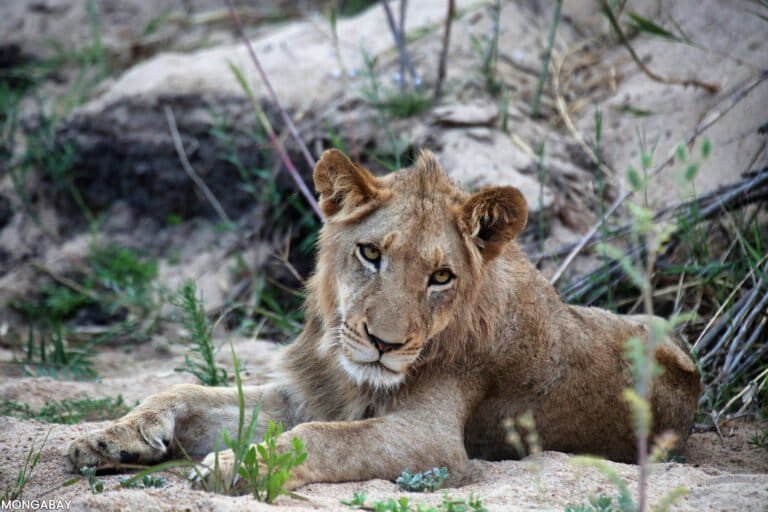
Lions on the Brink: A Sharp Population Decline (Image Credits: Imgs.mongabay.com)
Africa’s lions face a mounting crisis as organized poachers target them for bones, skins, teeth, and claws in a burgeoning black market trade.[1][2]
Lions on the Brink: A Sharp Population Decline
Conservationists documented a stark reduction in lion numbers over recent decades. Once thriving in the hundreds of thousands across vast territories, African lions now number between 22,000 and 25,000 adults and subadults. They occupy only about 6 percent of their historic range, a vulnerability reflected in their IUCN Vulnerable status.[1][3]
Researchers analyzed mortality records through the African Lion Database, revealing human-related deaths as a primary driver. In northern Kruger National Park, South Africa, lion counts fell 60 percent from 283 in 2005 to 122 by 2023. Such losses compound longstanding pressures from habitat fragmentation and prey scarcity.[2]
The Shift to Organized Exploitation
Poachers employed sophisticated tactics, including poisoned baits like giraffe carcasses that lured and killed entire prides in single events. Snares and traps claimed additional victims, often ensnaring multiple animals. These methods not only decimated lions but also collateral species such as vultures and other scavengers essential for ecosystem health.[1][4]
Authorities intercepted significant hauls, such as over 300 kilograms of lion parts in Maputo, Mozambique, in 2023 and 17 skulls in Zambia the previous year. Evidence pointed to deliberate targeting rather than mere opportunistic scavenging from conflict-killed lions.[2]
Demand Fuels Cross-Border Networks
Cultural and spiritual practices in at least 37 African countries drove local demand, where lion parts symbolized strength and protection. In West Africa, markets like those in Senegal sought skins and claws, with estimates suggesting needs for 32 to 169 lions annually despite tiny wild populations there.[3]
Transnational syndicates linked the trade to ivory, rhino horn, and pangolin scales, trafficking parts to Southeast Asia as tiger substitutes in traditional medicines. Restrictions on captive lion exports from South Africa in 2019 appeared to redirect pressure onto wild populations.[1]
- Mozambique emerged as a persistent hotspot, with deliberate poaching accounting for 25 percent of 426 human-related lion deaths from 2010 to 2023.
- South Africa’s Kruger and Zimbabwe’s Gonarezhou National Park reported rising incidents.
- Uganda, Botswana, Namibia, and Zambia also registered cases amid expanding networks.[4]
Pathways to Protection
Experts urged coordinated responses across six fronts. Enhanced monitoring via databases enabled hotspot detection and rapid interventions. Community partnerships offered benefits like livestock protection and ranger employment to curb conflicts.[3]
Intelligence-led enforcement targeted trafficking routes, while demand-reduction campaigns addressed cultural drivers. Peter Lindsey, lead study author, warned: “Poachers are increasingly using poisoned bait and snares that can wipe out entire prides in a single incident.” Samantha Nicholson added: “We’re seeing a serious threat emerge… But we’re also still at a point where action can make a real difference.”[1][3]
Key Takeaways
- Lion populations hover at 22,000–25,000 amid poaching surge.
- Organized networks exploit cultural and medicinal demands.
- Prioritize monitoring, enforcement, and community involvement for recovery.
Lions teeter on the edge, but targeted conservation holds promise for reversal. Protected areas could sustain far more lions with adequate support. What steps should governments take next? Share your thoughts in the comments.


