
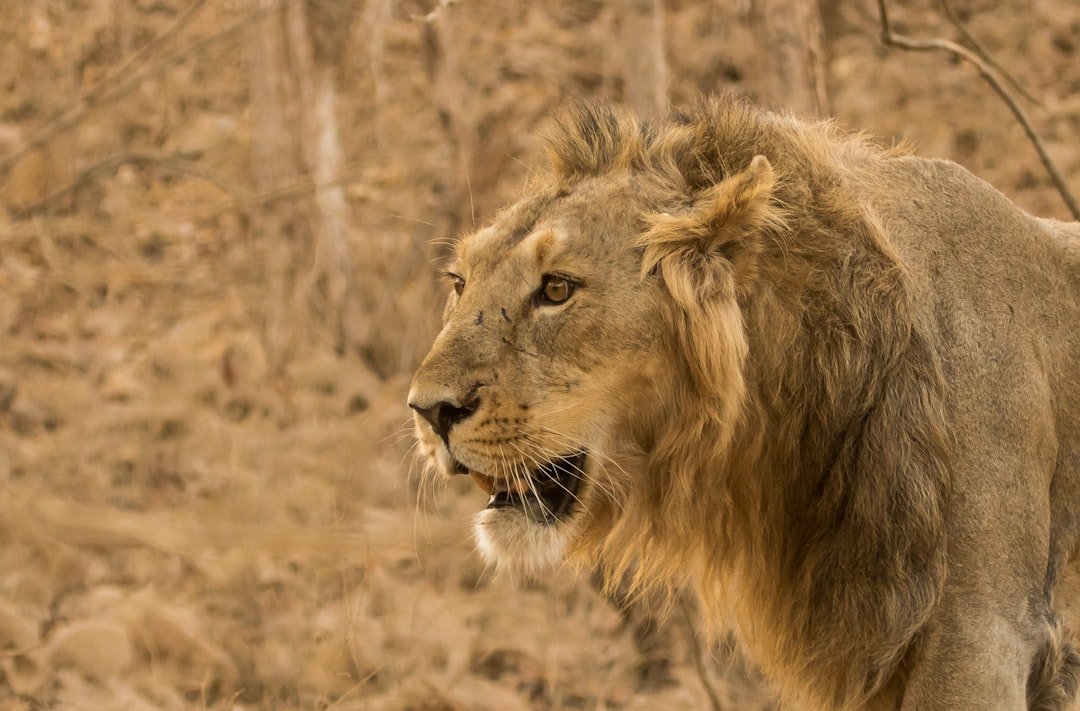
Rock Art Whispers of Lost Kings (Image Credits: Unsplash)
Saudi Arabia – The Prince Mohammed bin Salman Royal Reserve announced plans to reintroduce Asiatic lions into its vast landscapes, marking a potential revival of a predator absent from the Arabian Peninsula for more than 100 years.[1]
Rock Art Whispers of Lost Kings
Ancient engravings etched into desert rocks depict majestic lions prowling the Arabian Peninsula for at least 10,000 years. These big cats once shaped ecosystems across the region, from Syria to the sands of modern Saudi Arabia.[2]
Hunters drove them to extinction by the early 20th century. Today, wild Asiatic lions survive only in India’s Gir Forest, where roughly 900 individuals cling to existence in one of the world’s most precarious populations.[1]
Reserve chief executive Andrew Zaloumis highlighted this lost heritage. He noted the species’ deep historical ties to the land, fueling the drive to restore them.[1]
A Monumental Reserve Takes Center Stage
Spanning 2,450,000 hectares – more than twice the size of Yellowstone National Park – the Prince Mohammed bin Salman Royal Reserve stands as Saudi Arabia’s largest protected area.[1]
This diverse expanse includes mountains, deserts, lava fields, and coastal zones, supporting over 300 bird and mammal species alongside more than 300 plants. Officials envision it as the world’s premier desert reserve.[1]
The lion reintroduction forms part of a sweeping effort to restore 23 endangered or locally extinct species. Success here would position Saudi Arabia as only the second nation hosting wild Asiatic lions.[1]
Building on Proven Rewilding Successes
The reserve already boasts victories in species recovery. Teams reintroduced Arabian oryx, Arabian gazelle, and Nubian ibex, which now thrive in the protected habitats.
Common ostriches bred in Saudi Arabia for the first time in 80 years within these boundaries. Persian onagers returned last year after over a century away, while Arabian leopards loom on the horizon with breeding programs underway.[1][2]
- Arabian oryx: Successfully re-established populations.
- Arabian gazelle: Thriving in desert ecosystems.
- Nubian ibex: Adapted to mountainous terrain.
- Common ostrich: Recent breeding milestone after 80 years.
- Persian onager: Returned after 100+ years extinct locally.
Consultations and Community Buy-In
Plans remain in the consultation phase, with no set release date. Zaloumis emphasized board support, chaired by Crown Prince Mohammed bin Salman, amid efforts to engage local communities.
Releasing apex predators near human activity poses hurdles. Reserve leaders prioritize habitat restoration and staff training to mitigate risks and build lasting harmony.[1]
Smaller prides and overlapping territories define Asiatic lions, distinct from their African cousins with shorter, darker manes and prominent tail tufts. These traits suit the reserve’s varied terrain.
Key Takeaways
- Reserve size dwarfs major global parks, offering ideal space for lions.
- 23 species targeted in rewilding push, building on early wins.
- Community engagement critical for predator reintroduction success.
This initiative signals Saudi Arabia’s rising commitment to biodiversity amid Vision 2030 goals. Restoring keystone predators like the Asiatic lion could reshape desert ecosystems for generations. What do you think about bringing back these ancient icons? Share your views in the comments.


