
Dogs Do Feel Jealousy: What Key Studies Reveal
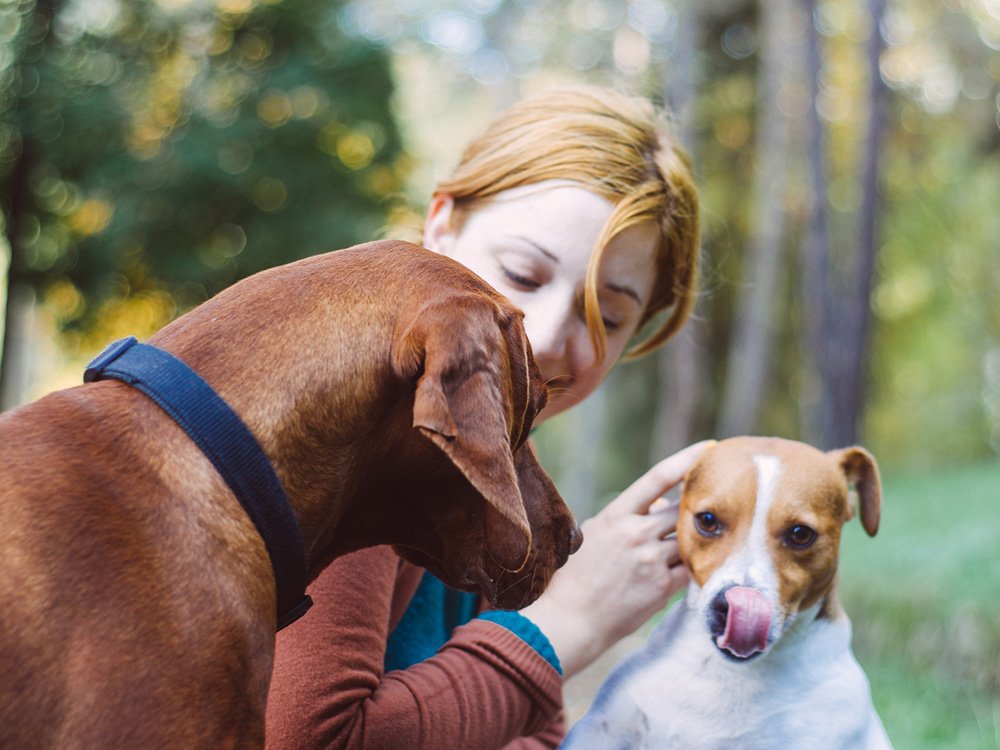
Early Experiments Sparked the Discovery (Image Credits: Images.ctfassets.net)
Dog owners frequently observe their pets inserting themselves between family members and newcomers, whining or pawing for undivided focus.
Early Experiments Sparked the Discovery
Researchers at the University of California, San Diego, conducted the first controlled test of jealousy in dogs back in 2014. They observed 36 dogs as owners interacted with either a realistic stuffed dog that barked and moved, a pumpkin pail, or a book.[1][2]
Dogs displayed far more attention-seeking and disruptive actions toward the fake dog, including snapping, pushing, and positioning themselves between the owner and the object. These reactions occurred twice as often compared to the neutral items. The findings suggested a primordial form of jealousy, akin to behaviors in human infants, rather than mere attention-seeking.[3]
Over 80 percent of owners in prior surveys had reported similar jealous outbursts, but this study provided empirical backing.[4]
Proof of Mental Imagery in Jealous Responses
A 2021 study from the University of Auckland took the research further by testing 18 dogs in scenarios where owners petted a fake dog either visibly or behind an opaque barrier.[5][4]
Jealous behaviors – such as vocalizations, leash-pulling, and agitation – intensified specifically when owners attended to the artificial rival, even out of sight. Lead author Amalia Bastos noted, “Our research supports what many dog owners firmly believe – dogs exhibit jealous behaviour when their human companion interacts with a potential rival.”[5]
This outcome indicated dogs could mentally represent the unseen interaction, hinting at cognitive processes beyond simple reactions.
Brain Activity and Evolving Evidence
Brain imaging research in 2018 captured heightened amygdala and caudate activity in dogs viewing a fake dog receiving rewards, mirroring human jealousy patterns.[6]
More recently, a 2025 study found companion dogs directing jealous actions toward non-living objects mimicking pets, reinforcing the emotion’s presence across contexts.[7]
Hormone oxytocin, linked to bonding and envy in humans, also plays a role in canines, tying into their social pack dynamics.[8]
Recognizing Jealousy in Everyday Life
Dogs often signal jealousy through predictable behaviors when attention divides.
- Pushing or wedging between owner and rival.
- Increased whining, barking, or vocal protests.
- Snapping or nipping at the perceived threat.
- Attention-grabbing antics like toy destruction or pacing.
- Body-blocking or leaning to reclaim focus.
- Selective sniffing or investigation of the intruder.
These actions typically arise around new pets, babies, or guests, stemming from resource protection instincts evolved in packs.[9]
Steps Owners Can Take
Addressing jealousy requires consistent strategies to rebuild security.
Owners reported success by distributing affection evenly and using positive reinforcement during multi-pet interactions. Training commands like “place” or “wait” helps dogs tolerate divided attention. Introducing rivals gradually, with supervised play, prevents escalation. In multi-dog homes, fair treat distribution curbs resentment, as one Vienna study observed dogs disobeying less when equity prevailed.[10]
Key Takeaways
- Dogs exhibit jealousy through targeted behaviors, backed by experiments since 2014.
- They mentally simulate unseen rivals, showing advanced emotional cognition.
- Equal attention and training mitigate outbursts effectively.
These studies affirm that jealousy forms a core part of canine emotional life, bridging human and animal experiences. Next time your dog shoots a pointed glance at a cuddling guest, science backs your intuition. What jealous moments has your dog pulled off? Tell us in the comments.