
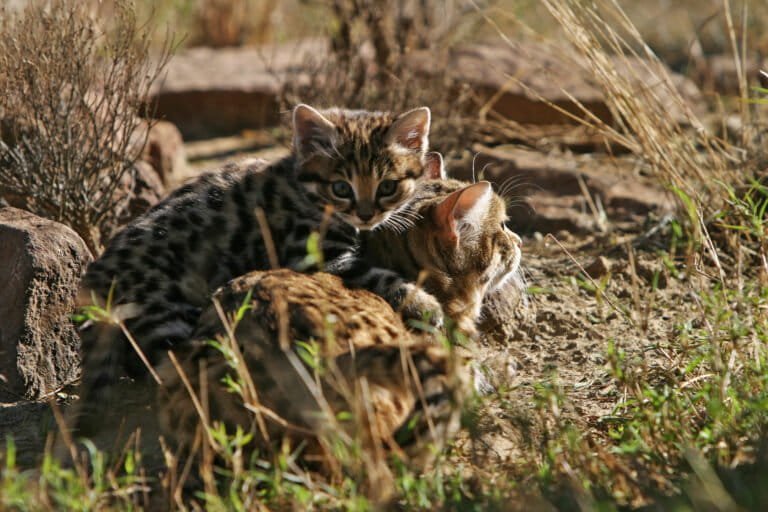
Researchers have long marveled at the black-footed cat, Africa’s smallest wild feline, which tips the scales at just 1 to 2.5 kilograms.[3] Standing about 20 centimeters tall at the shoulder, this spotted hunter boasts one of the highest prey success rates among cats, often exceeding 60 percent.[1]
Its tawny coat, dotted with dark spots, blends seamlessly into the dry landscape. Males occasionally tackle quarry larger than themselves, such as Cape hares. Females focus on smaller game to feed their young. This tenacious survivor navigates territories spanning 10 to 80 square kilometers, depending on food availability.[2]
Hunting Mastery After Sunset
Black-footed cats prowl nocturnally, covering 5 to 16 kilometers each night in zigzag patterns among bushes and termite mounds.[3] Their diet centers on rodents, small birds, and insects, with a single cat devouring up to 3,000 rodents annually.
They employ three distinct strategies to secure meals:
- The slow stalk, creeping at 0.5 to 0.8 kilometers per hour while scanning surroundings.
- The fast hunt, bounding at 2 to 3 kilometers per hour to flush prey from cover.
- The sit-and-wait tactic, perched motionless outside rodent burrows for up to 40 minutes.[3]
These methods allow the cats to thrive in prey-rich grasslands, even as larger predators roam nearby.
Borrowed Burrows as Daytime Shields
Daylight brings vulnerability, prompting black-footed cats to retreat underground into burrows abandoned by other animals. In southern Namibia, females overwhelmingly favor those excavated by springhares, large rodents resembling kangaroos.[1] These tunnels buffer extreme temperatures and offer protection from jackals and caracals.
Springhares constantly dig new systems, up to 30 meters wide with multiple entrances, providing a renewable network of refuges. Cats modify entrances slightly but rarely venture deep. Females with kittens rotate dens frequently – nearly daily once young start exploring – to dilute scents and evade predators. Of 184 resting sites recorded in one study, 98 percent were springhare burrows.[3]
Revelations from Recent Fieldwork
A 2022 study in Namibia’s Grunau region tracked five radio-collared females over 138 days. Each cat used an average of 12 burrows, lingering about two days per site.[2] Lead researcher Harold Brindley, from the University of Cape Town, noted that mothers stayed longer – around six days – before kittens gained mobility. “This is just another way cats depend on rodents – first for food, and now for shelter,” Brindley observed.[1]
The work, part of efforts by the Black-footed Cat Working Group, scanned over 50 burrows with LiDAR for precise measurements. Findings underscored near-exclusive reliance on springhare dens at the site, unlike varied options elsewhere.
Threats Loom for This Vulnerable Species
With a global population around 10,000, black-footed cats face steep declines from habitat fragmentation and low reproduction rates – one litter of up to two kittens yearly.[1] Springhare hunting for bushmeat and farmer culls exacerbate burrow shortages.
Overgrazing, poisoning for livestock predators, and disease further imperil them. Experts urge protecting working farmlands to sustain both cats and their burrow providers. Alexander Sliwa, project leader, warned, “The population is small and cannot recover quickly from mortality.”[1]
Key Takeaways
- Females average 12 burrows per season, rotating to dodge predators.
- Springhares supply essential, renewable shelters without becoming prey.
- Conservation hinges on safeguarding rodents and farmlands.
These diminutive dynamos highlight nature’s intricate balances – lose the burrows, and the cats’ future hangs in the balance. What steps should protect such elusive wonders? Share your thoughts in the comments.


