
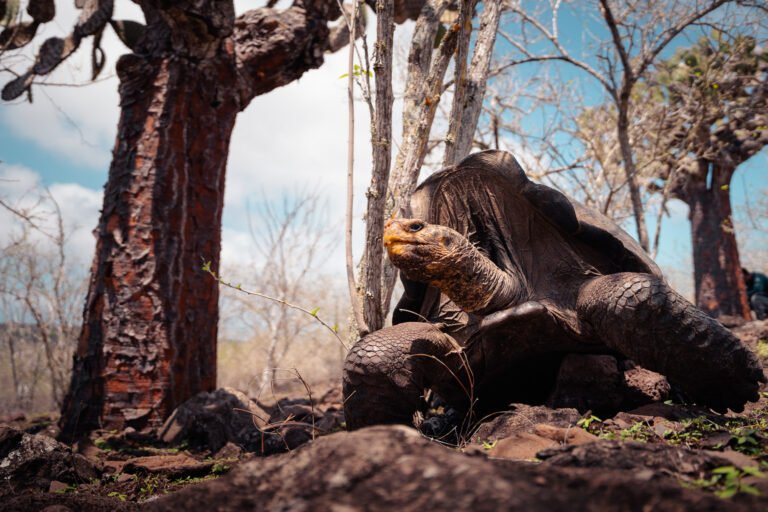
A Serendipitous Discovery Ignites Revival (Image Credits: Imgs.mongabay.com)
Floreana Island, Ecuador’s Galápagos Archipelago – juvenile giant tortoises ventured onto familiar volcanic soil this week, ending a 180-year absence driven by human exploitation.[1][2]
A Serendipitous Discovery Ignites Revival
Researchers uncovered a population of hybrid tortoises on Isabela Island’s Wolf Volcano in 2000, revealing genetic traces of the long-lost Floreana lineage.[1] These animals, descendants of the extinct Chelonoidis niger niger subspecies, offered a rare chance for restoration. The subspecies had vanished from Floreana by the 1840s, hunted relentlessly by sailors for food during long voyages.[3]
Genetic testing confirmed their ancestry, prompting a breeding program at a Santa Cruz facility. Over two decades, scientists raised hundreds of juveniles to maturity. On February 20, 2026, park officials released 158 of them, each fitted with GPS trackers for monitoring.[2] The timing aligned with the rainy season to aid survival.
Unveiling the Floreana Ecological Restoration Project
The Galápagos National Park Directorate spearheaded the effort, collaborating with groups like Galápagos Conservancy, the Charles Darwin Foundation, and Island Conservation. Floreana’s 160 residents played key roles through workshops and biosecurity measures. Lorena Sánchez, park director, described it as “one of the greatest challenges undertaken by the Galápagos National Park,” emphasizing science-based planning on an inhabited island.[2]
This initiative targets full ecosystem recovery, starting with invasive species removal and habitat work. The tortoise release stands as the first of 12 planned reintroductions. Community leader Verónica Mora noted, “Their return shows what is possible when a community leads and many partners come together.”[2] Experts raised the tortoises for 12 to 14 years before deeming them ready for the wild.
Keystone Species Reshape the Landscape
Giant tortoises function as ecosystem engineers, grazing vegetation to maintain open habitats and dispersing seeds across vast distances. Their wallows create microhabitats that benefit soil health and other wildlife. On Floreana, their absence allowed invasive plants to dominate, altering the island’s ecology for generations.[1]
Restoration experts anticipate cascading benefits. Native plants should regenerate, improving conditions for birds that ferry marine nutrients inland. Rakan Zahawi of the Charles Darwin Foundation explained that tortoises “help rebuild ecological processes that many other species depend on.”[2]
- Graze to control invasive overgrowth
- Disperse seeds of native flora over long distances
- Enhance soil fertility through foraging and waste
- Create wallows that retain water and support invertebrates
- Promote biodiversity by opening closed-canopy areas
- Strengthen land-sea links via bird habitat improvement
Charting a Path Forward
Annual releases of 25 to 100 tortoises will follow, building toward a self-sustaining population. Trackers will track movements, health, and habitat use to refine strategies. The project models restoration on populated islands worldwide, balancing conservation with human needs.[1]
Success here could pave the way for species like the Floreana mockingbird and racer snake. Dr. James Gibbs of Galápagos Conservancy reflected on the 2000 find: “suddenly they were all over… tortoises all over.”[1] Monitoring will span decades as the ecosystem rebounds.
Key Takeaways
- 158 GPS-tagged juveniles launched the restoration of a keystone species absent since the 1840s.
- Multi-decade collaboration revived a lineage through hybrids from Isabela Island.
- Tortoises will drive vegetation recovery, benefiting biodiversity and island residents alike.
This release restores not just a species, but vital processes that sustained Floreana’s unique biodiversity for millennia. As these ancient survivors roam freely, they signal hope for global conservation efforts. What do you think about this restoration triumph? Tell us in the comments.


