

Have you ever wondered why your dog seems to fall apart emotionally at the exact moments you do? You’re running late, your heart is hammering, your nerves are frayed, and suddenly your dog is spinning in circles, barking at absolutely nothing. It’s almost eerie. Like they read the room before you even walked in.
There’s actually a really fascinating and deeply human story behind this dynamic, one that science is only beginning to catch up with. If you identify as a highly sensitive person (HSP), someone who feels things deeply, gets easily overstimulated, or picks up on the subtlest emotional shifts in a room, there’s a good chance your dog is running on a very similar frequency. Let’s explore exactly why, and what you can do about it.
The Science Behind Sensitive Souls – Human and Canine
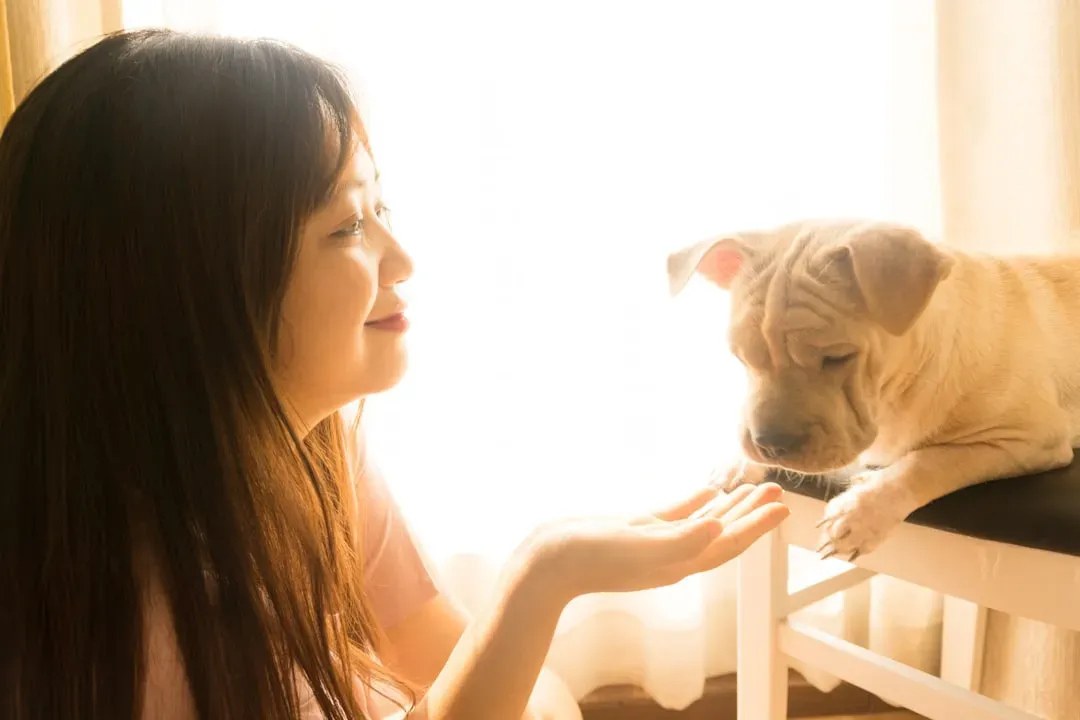
Sensory Processing Sensitivity (SPS) is a personality trait in humans characterised by a tendency to process information deeply, to be easily overstimulated, and to have strong emotional responses and an enhanced sensitivity to subtle stimuli. Honestly, that description probably feels a little too familiar if you’re an HSP. You’re not imagining things. This is real, measurable, and deeply wired into your nervous system.
The idea of high sensitivity originally comes from human psychology, thanks to Dr. Elaine Aron, who introduced the concept of the Highly Sensitive Person (HSP) in the 1990s. Aron’s work highlighted that roughly 15 to 20 percent of the human population has a more finely tuned nervous system, leading them to be more sensitive to stimuli, emotions, and social dynamics.
A trait similar to SPS has recently been identified in dogs, referred to as canine Sensory Processing Sensitivity (cSPS). So no, your dog is not just “dramatic.” They may genuinely be wired that way, just like you. Human and demographic factors only marginally affected the highly sensitive dog score, suggesting that, as hypothesized for human SPS, a genetic basis may underlie this dimension within the dog species.
Your Dog Is Literally Absorbing Your Stress
Here’s the thing that might stop you mid-scroll: your emotional state is not just felt by your dog, it is biologically mirrored in their body. This isn’t poetic language. It’s measurable physiology.
Researchers determined stress levels over several months by measuring the concentration of cortisol in hair from both the dog and their owner. They found that the levels of long-term cortisol in the dog and its owner were synchronised, such that owners with high cortisol levels have dogs with high cortisol levels. Think of cortisol as a shared emotional diary written in hair. Your stress becomes their story.
Although dogs’ personalities had little effects on their cortisol levels, the human personality traits of neuroticism, conscientiousness, and openness significantly affected dog cortisol levels. Hence, researchers suggest that dogs, to a great extent, mirror the stress level of their owners. That’s a finding that should make every HSP dog parent sit up and take notice.
When Two Sensitive Souls Share a Home

Imagine two people who both startle easily living together in a small apartment. Every time one jumps at a sound, the other does too. Now imagine one of them can’t speak and can only process the world through their nose, ears, and your facial expressions. That’s essentially what’s happening between an HSP and a highly sensitive dog.
HSPs, people and pets alike, may be absorbing and responding to unusually high quantities of information at any given time. This is what can contribute to the overwhelm and corresponding reactive behavior, including fight, flight, freeze, and other coping responses.
Research demonstrates that canine sensory processing sensitivity interacts with owner personality and use of aversive communication to influence the likelihood of behaviour problems in dogs. More behaviour problems were reported for more highly sensitive dogs when there was a relative mismatch between owner and dog personality. When the match is a sensitive person with a sensitive dog, the amplification can go both ways. Beautifully, and sometimes explosively.
Recognising the Signs: What Reactive Behaviour Actually Looks Like
Let’s be real, many HSP dog owners have been told their dog is “just badly behaved” when the truth is far more nuanced. Knowing what you’re actually dealing with is the first step to helping your dog.
Reactive dogs become overly aroused by common stimuli. They may lunge, bark, and growl, becoming so preoccupied with whatever is triggering the emotion that they can be difficult to control and move out of the situation. Sound familiar? It’s overwhelming for them, just as sensory overload is overwhelming for you.
A highly sensitive dog may have a strong drive for safety and security to the point where submission, aggression, resource guarding, reactivity, and separation anxiety can at times crop up. They are also often on alert in a way that frequently appears to be anxiety or uneasiness. Watch your dog’s body, not just their behaviour. Stiff posture, raised hackles, whale eye, and a tight mouth are all signals that they’re being pushed past their comfort zone.
The Overprotection Trap HSPs Often Fall Into
This one is hard to hear, but I think it’s worth saying gently. HSPs tend to be deeply empathetic and nurturing. In theory, amazing dog parent traits. In practice, they can accidentally make reactivity worse by trying too hard to shield their dog from discomfort.
Owners’ anxiety may affect dogs indirectly through overprotectiveness, thereby restricting the dog’s ability to familiarize itself with novel situations, or through the use of coercive dog-training methods. Swooping in to rescue your dog from every mildly uncomfortable social moment actually communicates one message loud and clear: “This is dangerous. You’re right to be afraid.”
While social experiences are important, it’s crucial to take things slow. Introduce new environments, people, and animals gradually, allowing your dog to adjust at their own pace. The goal is not to push, not to wrap in cotton wool either. It’s a gentle, consistent middle path that builds real confidence over time.
Practical Steps for Sensitive Owners With Reactive Dogs
The good news? This is absolutely workable. The even better news is that the same emotional intelligence that makes you an HSP is your greatest asset here. You just need to channel it strategically rather than emotionally.
A dog living with a calm, emotionally stable owner is more likely to be relaxed, confident, and socially adaptable. Conversely, a dog living with high emotional tension may exhibit hyperactivity, reactivity, or withdrawal. Your inner work matters as much as your dog training work. Mindfulness, therapy, even simply learning to regulate your own nervous system before walks can have a meaningful ripple effect on your dog.
Counter-conditioning changes your dog’s emotional response to triggers by creating positive associations. Instead of fear or frustration, your dog learns to associate their trigger with amazing things. This isn’t about suppressing behaviour, it’s about changing how your dog feels. Pair this with routine, since highly sensitive dogs thrive on it, and regular feeding times, walks, and play sessions can help them feel secure and reduce anxiety. Predictability is a lifeline for a nervous system already running hot.
Conclusion: You and Your Dog Are More Alike Than You Know
There is something genuinely moving about understanding that the bond between an HSP and a reactive dog is not a burden. It’s a mirror. Your dog is showing you something about the world you both share, and honestly, about yourself too.
The research is clear. There is evidence suggesting that owners’ trait anxiety contributes to their dogs’ fear and anxiety-related behaviour to some degree, and understanding the path linking owner anxiety and dog behaviour problems helps both owner and dog. That path flows in both directions, which means healing can too.
Your sensitivity is not a flaw. Neither is your dog’s. Having a highly sensitive dog is both a challenge and a gift. These dogs can be incredibly loyal and deeply connected to their humans, but they also require a bit more patience and understanding. By recognizing their unique needs and adjusting your approach, you can help your sensitive dog lead a happy, enriched life.
So here’s a gentle question to sit with: If your dog is reflecting your emotional world back at you, what might their behaviour be lovingly trying to tell you today? Drop your thoughts in the comments – we’d love to hear your story.


