

You come home after a rough day, not saying a word, and your dog is already at your side, tail wagging gently, eyes soft with understanding. It feels uncanny, doesn’t it? Like they’ve somehow read your emotional state through some invisible force. You might even wonder if there’s something supernatural about how deeply dogs seem to know us. Turns out, the truth is even more fascinating than any psychic ability.
The bond between humans and dogs goes back thousands of years, and over all that time, our furry companions have developed an extraordinary toolkit for understanding us. Scientists have spent years unraveling this mystery, and what they’ve discovered challenges everything we thought we knew about interspecies communication. Your dog isn’t psychic, but what they can do might be even more impressive. Let’s dive in.
The Secret Language of Facial Expressions

Here’s something wild: dogs can integrate two different sources of sensory information into a coherent perception of emotion, requiring a system of internal categorization of emotional states. Think about that for a second. Your dog doesn’t just see you smile or hear your happy voice separately. They’re putting these pieces together like a puzzle, forming a complete picture of how you’re feeling.
Dogs are surprisingly skilled at reading human body language and facial expressions, and experiments demonstrate that pet dogs can distinguish a smiling face from an angry face, even in photos. What makes this particularly remarkable is that they don’t need training for it. It’s like they’ve evolved to become little emotion detectors, fine tuned specifically to decode human feelings.
Researchers found that in every case dogs were able to select the angry or happy face more frequently than could be expected by random chance. Interestingly, it took dogs longer to associate an angry face with a reward, suggesting that their prior experience told them to steer clear of people when they look angry. Let’s be real, that’s pretty smart survival instinct right there.
Your Voice Tells Them Everything

Dogs possess voice-processing regions in their temporal cortex that light up in response to vocal sounds, and brain scans reveal that emotionally charged sounds like a laugh, a cry, or an angry shout activate dogs’ auditory cortex and the amygdala. Basically, their brains are wired to pick up on the emotional tone of your voice, not just the words you’re saying.
I think we’ve all seen this in action. You can say “bad dog” in a cheerful voice, and your pup will still wag their tail. Say “good boy” in an irritated tone, and they’ll slink away with their ears back. Scientists have shown that dogs can hear mood in the tone of voice, with sounds of happiness resulting in positive reactions like tail wagging, whereas sadness and fear can result in negative reactions like yawning.
The fact that dogs respond to how we say things rather than what we say reveals something profound about their emotional intelligence. They’ve learned to navigate our world by tuning into our emotional broadcasts, reading between the lines in ways that honestly put some humans to shame.
The Nose Knows Your Stress

Get ready for this one. Dogs can smell stress represented by higher levels of the hormone cortisol, and they also react to it emotionally. Yeah, you read that right. Your dog can literally smell when you’re stressed, anxious, or scared. It’s not magic. It’s biology.
When the stress odor was present, dogs were less likely and slower to approach a bowl that they were uncertain contained a treat, suggesting that being stressed around your dog may have a negative effect on your dog’s mood. So your anxiety doesn’t just live in your head. Your dog picks it up through scent and it actually changes their behavior and decision making.
Dogs can smell the difference between emotional states without training, giving off a variety of chemical signals. The really interesting part? These stress odors were from unfamiliar people, suggesting a common stress smell among individuals that dogs can identify rather than just learning the smell of their stressed owner from previous experience. That’s a universal stress detector right there.
Honestly, it makes you wonder what else they’re picking up that we have no clue about. Their olfactory world is so much richer than ours, filled with invisible information we can’t even begin to comprehend.
The Chemistry of Connection

When dogs and humans make gentle eye contact, both partners experience a surge of oxytocin, often dubbed the love hormone, and owners who held long mutual gazes with their dogs had significantly higher oxytocin levels afterwards, and so did their dogs. This is the same hormonal loop that bonds mothers to their babies. Dogs have essentially hijacked our maternal bonding system.
Nasally administered oxytocin increased gazing behavior in dogs, which in turn increased urinary oxytocin concentrations in owners, supporting the existence of an interspecies oxytocin-mediated positive loop facilitated by gazing. It’s a feedback loop of love, if you will. You look at your dog, you both feel good, so you keep looking at each other, and the bond just keeps getting stronger.
Here’s the kicker: Tests with wolves showed that even wolves raised by humans did not communicate by eye gazing and did not experience an oxytocin feedback loop. This isn’t just about domestication making animals tame. Dogs have evolved something unique and specific with humans, a chemical connection that doesn’t exist with any other species.
Emotional Contagion and Stress Synchronization

This study reveals, for the first time, an interspecies synchronization in long-term stress levels between dog-human dyads, containing both pet and competing dogs. Your stress becomes their stress. Dogs’ stress levels were greatly influenced by their owners and not the other way around, with findings suggesting that dogs mirror the stress levels of their owners.
It’s hard to say for sure, but this stress mirroring could be both a blessing and a burden. On one hand, it shows how deeply connected we are. On the other, it means our anxious energy directly impacts our dogs’ wellbeing. Some dog-human pairs had synchronized cardiac patterns during stressful times, with their heartbeats mirroring each other. That’s not just companionship. That’s physiological unity.
Think about what that means for your relationship with your dog. Every time you’re stressed, frustrated, or overwhelmed, they’re experiencing a version of that alongside you. It makes you think twice about bringing your work stress home, doesn’t it?
Reading Your Intentions, Not Your Mind

Dogs probably aren’t pondering why you’re upset or realizing that you have distinct thoughts and intentions, but they excel at picking up on what you’re projecting and respond accordingly, meeting us emotionally in a way few other animals can. So while it might feel like mind reading, it’s actually something more impressive: behavioral and emotional pattern recognition at an expert level.
Analysis of dogs’ behavior shows they behave differently based on their owner’s emotions, but researchers say it’s unlikely that dogs are empathizing with us, as dogs seem to keep their distance when owners are sad and don’t appear to exhibit more helpful or comforting behaviors. That might sound harsh, but it doesn’t make the bond any less real. Dogs respond to our emotions in ways that make sense for them, not necessarily in ways that match human empathy.
Thousands of years living as our companions have fine-tuned brain pathways for reading human social signals, and while a dog’s brain may be smaller than a wolf’s, it may be uniquely optimized to love and understand humans. Evolution has shaped them to be our perfect companions, even if that doesn’t mean they understand sadness the way we do.
The Power of Paying Attention

Humans are the center of the canine world as they depend on us for the basics of life, so they monitor our every move, knowing when we are rushed or relaxed, happy or mad, focused or available for play time, realizing our moods affect them. Your dog is basically conducting a constant surveillance operation on your emotional state because their wellbeing depends on correctly reading you.
Dogs do not have to understand every spoken word to get the gist of a conversation, since only about ten percent of what humans communicate is actually verbal, and dogs have learned to monitor physical actions very closely, as non-verbal posture, gestures, body carriage, and facial expressions communicate roughly ninety percent of what we have to say. They’re reading the ninety percent we don’t even realize we’re broadcasting.
So when your dog seems to anticipate your next move before you make it, they’re not reading your thoughts. They’re reading your body, your face, your energy. They’ve spent their entire lives studying you like you’re the most important subject in the universe. Because to them, you are.
Conclusion
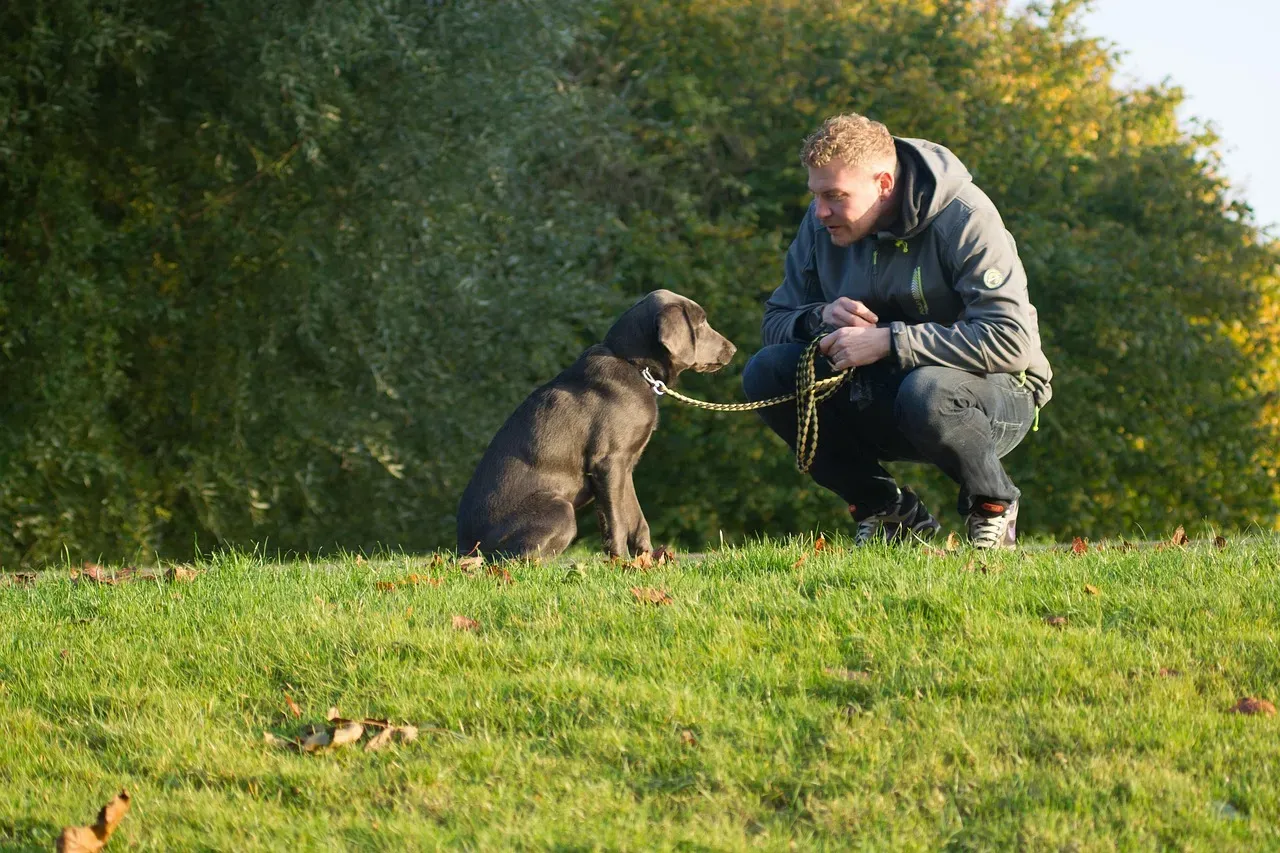
Your dog can’t read your mind in the supernatural sense, but what they can do is arguably more meaningful. They’ve evolved alongside us for thousands of years, developing an extraordinary ability to decode our facial expressions, vocal tones, body language, and even the chemical signals our bodies release when we’re stressed or happy. They’ve tapped into our maternal bonding system through oxytocin, creating a feedback loop of affection that’s unique in the animal kingdom.
This isn’t just interesting science. It has real implications for how we live with our dogs. Your emotional state matters to them, not just because they care about you, but because it physiologically affects them too. The stress you carry becomes stress they experience. The joy you feel amplifies their joy. You’re not just living with a pet. You’re part of an emotional feedback system that runs deeper than most of us realize. So next time your dog looks at you with those knowing eyes, remember they’re not reading your mind, but they are reading you in ways that science is only beginning to fully understand.
What do you think? Does knowing the science behind your dog’s intuition make the bond feel more or less magical? Share your thoughts in the comments.


