
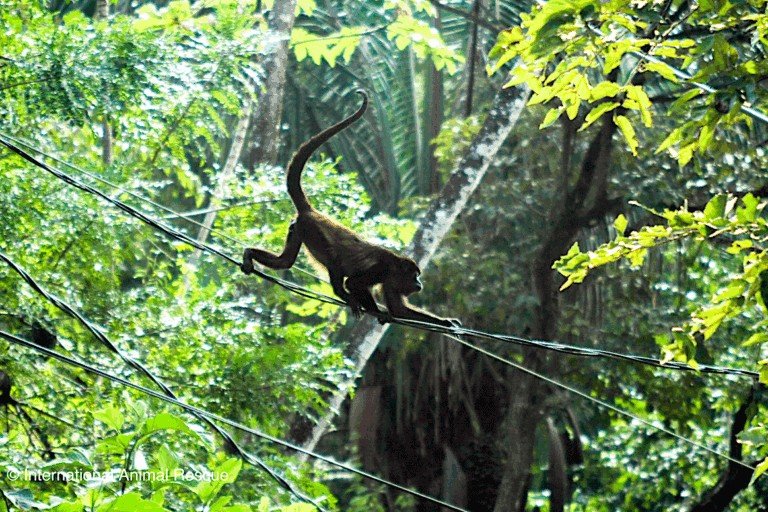
Electrocutions Plague Tree-Dwelling Species (Image Credits: Imgs.mongabay.com)
Nosara, Costa Rica – A groundbreaking ruling from the nation’s Constitutional Court compelled authorities to address the lethal threat posed by uninsulated power lines to local wildlife.[1][2]
Electrocutions Plague Tree-Dwelling Species
Wildlife in the Nosara district of Guanacaste faced relentless danger from bare electrical wiring strung across treetops. Howler monkeys, sloths, and squirrels frequently met tragic ends while traversing these lines in search of food or territory. Conservation reports highlighted Nosara as a hotspot for such incidents, where exposed wires and poorly maintained infrastructure amplified the risks.[1]
Veterinarian Francisco Sánchez Murillo noted the severity of the problem. “Bare electrical wiring is a widespread problem in Costa Rica especially affecting rural areas,” he stated. “In Nosara, the issue has been especially visible due to the constant wildlife electrocutions in the area.” These deaths disrupted ecosystems, as howler monkeys played crucial roles as seed dispersers.[1]
Conservationists Launch Constitutional Challenge
A coalition of 20 organizations, known as “Esto No Es Pura Vida,” rallied against the ongoing losses. Led by the International Animal Rescue Costa Rica, the group gathered veterinary data and scientific evidence to build their case. On July 3, 2025, law firm Alta Legal filed a constitutional appeal on their behalf, targeting the Ministry of Environment and Energy (MINAE) and the Costa Rican Institute of Electricity (ICE).[2]
The appeal invoked Article 50 of Costa Rica’s Political Constitution, which guarantees a healthy environment. Activists pointed to national figures showing 6,262 electrocution cases between June 2022 and June 2023 alone. Despite a 2024 MINAE decree requiring insulation and impact assessments, enforcement lagged, prompting the legal action.
Court Delivers Partial Victory with Strict Timeline
On January 16, 2026, the Constitutional Chamber of the Supreme Court partially upheld the appeal. Judges determined that ICE and MINAE breached their duties by installing bare wiring in new Nosara projects, heightening electrocution risks. The court rejected broader claims but zeroed in on documented violations in the area.[2]
ICE and MINAE received a six-month deadline to implement mitigating measures, such as insulating lines and rerouting cables. Non-compliance carried severe penalties, including fines and potential imprisonment for officials. This enforcement mechanism marked a shift toward accountability in environmental protection.[1]
Precedent Sets Stage for Nationwide Change
The decision resonated beyond Nosara, establishing a legal benchmark for handling wildlife hazards from infrastructure. Attorney Marvin Carvajal of Alta Legal emphasized its reach: “From now on, any electricity trading company will have to act in accordance with the precedent or face a judgment against it if it does not comply.” Dr. Murillo praised the role of data collection in securing results.[2]
Urbanization and habitat fragmentation worsened the crisis, pushing arboreal animals into contact with power grids. Conservationists hoped the ruling would spur similar actions elsewhere, aligning development with biodiversity preservation. Elena Kukovica of International Animal Rescue described the cascading effects on monkey troops and regional flora.
This verdict underscored that environmental rights demand concrete action, not just policy promises. As Costa Rica balances growth and conservation, such rulings pave the way for safer coexistence. What steps should other nations take to protect wildlife from human infrastructure? Share your thoughts in the comments.


