
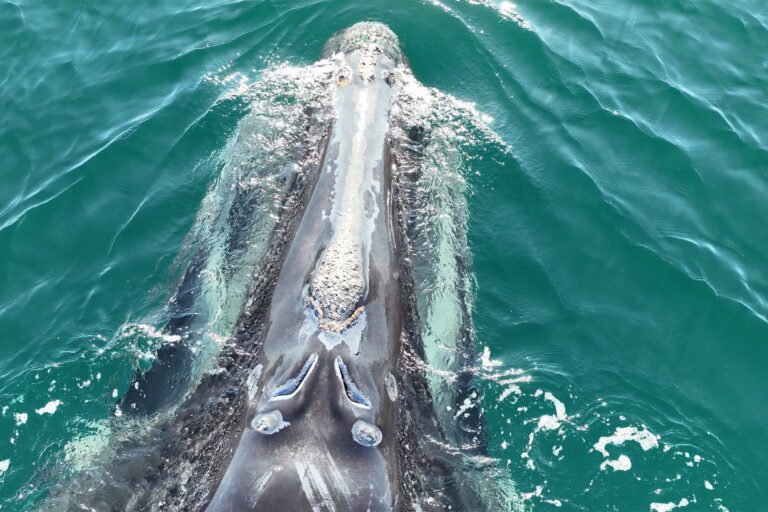
A Swift Decline After Partial Rescue (Image Credits: Imgs.mongabay.com)
North Carolina – The partial remains of a four-year-old North Atlantic right whale named Division surfaced off the coast in late January, marking another loss for one of the world’s most endangered marine species.[1][2]
A Swift Decline After Partial Rescue
Responders spotted Division entangled in fishing gear on December 3, 2025, near Jekyll Island, Georgia. Teams from NOAA Fisheries, the Georgia Department of Natural Resources, and others conducted a partial disentanglement the following day, removing some of the roughly 300 feet of rope wrapped around his head, mouth, and blowhole.[3][4] The gear had cut deeply into his tissues, but weather and the whale’s offshore position prevented full removal.
Division migrated northward toward New England feeding grounds before turning south again. Observers noted his worsening condition, including patches of whale lice and persistent lines trailing from his body. He appeared for the last time alive on January 21 off Cape Hatteras, before his carcass emerged six days later, 25 miles offshore of Avon.[1] Dangerous seas ruled out recovery or examination, though federal experts planned to analyze the retrieved gear.[1]
From Promising Calf to Repeated Victim
Born in December 2021 to mother Silt, Division earned his name from callosity patterns resembling a mathematical division symbol. Cataloged as #5217, he amassed 68 sightings across key habitats, often captured leaping or alongside family.[5] Yet his young life already bore scars from three prior entanglements, a pattern all too common for his kind.
Experts at the New England Aquarium confirmed his identity through images. Heather Pettis, a senior scientist there, remarked, “While this outcome is not a surprise given the severity of the entanglement, it’s still incredibly disheartening to bear witness to the death of a critically endangered right whale.”[1] This marked the first confirmed North Atlantic right whale death since May 2024.[1]
Threats Mounting Against a Fragile Population
North Atlantic right whales number around 380, with just 70 to 72 reproductive females remaining. The species requires about 50 calves annually for recovery, yet only 15 arrived this winter – a flicker of hope overshadowed by persistent dangers.[5][6]
Entanglements and vessel strikes dominate mortality causes. Since 1980, over 1,900 such incidents scarred more than 85 percent of the population, with roughly 100 entanglements yearly amid a million fishing lines in migration paths.[6]
- Fishing ropes constrict mouths and tails, hindering feeding and fleeing.
- Vessel collisions inflict blunt trauma in busy shipping lanes.
- Cumulative injuries shorten lifespans from potential centuries to mere decades.
- Slow surface feeding and coastal migrations amplify exposure.
Conservation Efforts Face Hurdles
Groups push innovations like ropeless or on-demand gear and breakaway ropes to minimize risks. Aerial surveys and response teams, backed by agencies including NOAA and the U.S. Coast Guard, track and aid entangled whales.[4] Vessel speed reductions in high-risk zones also show promise.
Still, adoption lags, prompting criticism. Oceana’s Nora Ives stated, “Another whale has died, and the blame lies squarely with the government… We need urgent action now.”[6] Advocates urge faster regulatory shifts and funding for NOAA to avert collapse.
Key Takeaways
- Division’s death underscores how repeated entanglements doom even young whales.
- With 380 left, every individual counts toward species survival.
- Ropeless gear and policy reforms offer proven paths to prevention.
Division never mated or sired calves, cutting short a lineage in a population hanging by a thread. His story demands accelerated change to safeguard future migrations. What steps should fisheries take next? Share your thoughts in the comments.


