
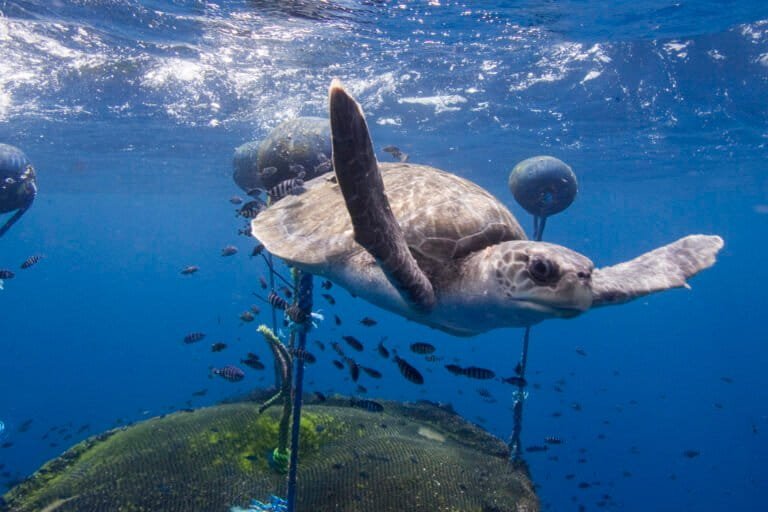
Fish Aggregating Devices Fuel Tuna Harvests (Image Credits: Imgs.mongabay.com)
Santa Cruz, Galápagos Islands, Ecuador – Discarded fishing gear from industrial tuna operations drifts relentlessly into the renowned Galápagos Marine Reserve, turning a biodiversity jewel into a snare for endangered species.[1]
Fish Aggregating Devices Fuel Tuna Harvests
Industrial purse-seine vessels deploy fish aggregating devices, or FADs – known locally as plantados – to concentrate schools of tuna and baitfish. These structures feature a surface platform tethered to submerged netting that mimics natural habitats, drawing predators like yellowfin tuna.
Equipped with satellite buoys and sonar, FADs alert crews to prime fishing spots, boosting efficiency across the eastern Pacific. Fleets from 11 nations, including Ecuador’s growing armada, release tens of thousands yearly, according to regional fisheries data.[1]
Vessels often abandon the bulky platforms after harvests, retaining only buoys for reuse. Lost signals from dead batteries or excessive drift exacerbate the problem, leaving debris to roam freely.
Currents Carry Hazards into Protected Waters
Ocean currents such as the Humboldt from the south and Cromwell from the west funnel abandoned FADs into the 133,000-square-kilometer reserve. Since 2017, authorities logged 277 sightings, though underreporting suggests higher totals.[1]
Artisanal fisher Walter Borbor spotlighted the issue in a 2022 social media video, showcasing a plantado coiled around a decomposing whale’s tail. Borbor has retrieved dozens over years, often during routine outings near islands like Santa Cruz and Floreana.[2][1]
Without unified tracking in Ecuador, these incursions persist, colliding with small boats and shedding plastics across reefs.
Entanglement and Pollution Ravaging Wildlife
Once adrift, FADs become ghost gear, ensnaring marine life in their nets. Dead sharks, turtles, and sea lions wash ashore, victims of prolonged strangulation.
Affected species include loggerhead turtles, Galápagos sea lions, whale sharks, manta rays, dolphins, and seabirds. Coral damage from drifting platforms disrupts habitats for fish like the yellowtail surgeonfish. Plastics fragment over time, adding to the ocean’s debris burden.[1]
- High bycatch rates deplete juvenile tuna stocks.
- Reef collisions scar sensitive ecosystems.
- Net remnants poison food chains through ingestion.
- Navigation hazards endanger local fishers.
Collaborative Cleanups and Regulatory Momentum
Local fishers lead retrievals, supported by groups like TUNACONS, which offers $400–$600 per unit recovered. Over three years, the program dismantled about 60 FADs, recycling components where possible.[1]
Galápagos National Park coordinates with the Charles Darwin Foundation and Galápagos Conservation Trust, using current models to predict drifts. Frente Insular campaigns urge reporting via media outreach.
The Inter-American Tropical Tuna Commission advances reforms: non-entangling designs by 2025, partial biodegradability in 2026, and full by 2029. A proposed registry would tag platforms for accountability, while an upcoming workshop eyes regional strategies.[1]
Challenges remain, including unlimited deployments and traceability gaps, but prevention trumps reaction.
Key Takeaways
- 277 FADs reported in reserve since 2017, likely undercounted.
- Wildlife entanglements span sharks to seabirds.
- IATTC rules phase in eco-friendly FADs through 2029.
Stronger monitoring and owner liability could stem the tide, preserving the Galápagos’ evolutionary legacy. What steps should tuna fleets take next? Share your views in the comments.


