
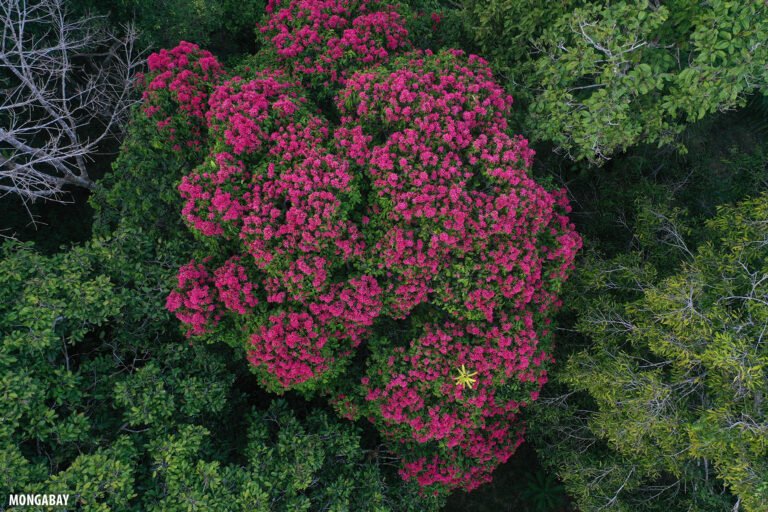
Overlooked Heights Challenge Traditional Surveys (Image Credits: Imgs.mongabay.com)
Peruvian Amazon – A pioneering effort combined drone flights with environmental DNA sampling to expose the vibrant vertebrate life dwelling high above the forest floor.[1]
Overlooked Heights Challenge Traditional Surveys
Forests tower over researchers, shielding canopy inhabitants from conventional tools. Camera traps captured ground dwellers effectively, yet arboreal species evaded detection. Acoustic devices picked up vocal animals but overlooked silent ones.
These limitations left scientists grasping at incomplete pictures of ecosystem health. Dense foliage and extreme heights compounded the issue in regions like the Peruvian Amazon, where threats from agriculture, mining, and roads loomed large. A data void persisted for tree-dwelling vertebrates.
Steffen Kirchgeorg, a postdoctoral researcher at ETH Zürich’s Environmental Robotics Lab, addressed this gap head-on. His team sought methods to reach inaccessible zones without disturbance.[1]
Innovative Tech Probes the Treetops
Drones equipped with specialized probes transformed sampling. Operators selected sites and plotted flight paths beforehand. The device hovered above, then lowered a tether-attached tool featuring a moist cloth pad.
The probe rubbed deliberately against branches and leaves, capturing genetic traces like hair, fur, saliva, and skin cells. Later missions automated the descent for efficiency. “We want to maximize the amount that we collect within a given flight,” Kirchgeorg explained. He noted eDNA’s random distribution demanded repeated contacts.[1]
Wilderness International partnered in the pilot across two protected areas flanking Peru’s Tambopata River. Teams validated results against established ground surveys. This non-invasive approach preserved habitats while yielding lab-ready material.
Striking Discoveries from the Samples
Analysis revealed 257 vertebrate species across collections. One standout sample harbored traces from 50 distinct types. Findings aligned closely with prior terrestrial records, confirming reliability.
Marie Schreiber, Wilderness International’s head of science communication, highlighted the match: “It also matches with our traditional ground data.” She emphasized the rarity of individuals per species amid high diversity.[1]
- Probes targeted arboreal vertebrates missed by ground efforts.
- Samples captured eDNA from mucus, feces, and shed cells.
- Automation boosted contact time and yield per flight.
- Results supported known local fauna inventories.
- Diverse vertebrates signaled robust, understudied canopy ecosystems.
Bridging Gaps with Complementary Strategies
Water samples offered a fuller species tally but overlapped minimally with canopy data. Aerial collections spotlighted unique taxonomic groups absent from aquatic traces. Schreiber stressed the synergy: canopy methods filled voids in water-focused protocols.
This duality proved essential for holistic assessments. Water dominated overall detections, yet treetop swabs unveiled specialized canopy communities. Researchers advocated pairing techniques for comprehensive monitoring.
Kirchgeorg pointed to scalability hurdles like costs and logistics. Political instability sometimes barred drone access. Still, declining eDNA sequencing prices promised broader adoption.[1]
Key Takeaways:
- 257 vertebrate species detected, including 50 in a single canopy sample.
- Minimal overlap between canopy and water eDNA, urging combined use.
- Tech validates against ground data, bolstering conservation arguments.
Drone eDNA sampling equips conservationists with powerful evidence to safeguard canopy realms amid escalating deforestation. Schreiber underscored its value: “This is data with a lot of impact because it helps in justifying the establishing of new conservation areas.”[1]
Future deployments could fortify protections in vulnerable Amazon stretches. How might this technology reshape global forest monitoring? Share your thoughts in the comments.


