
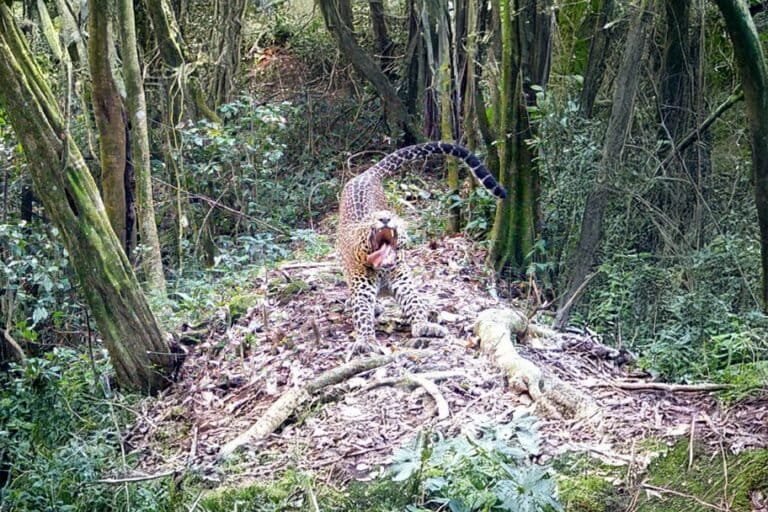
Viral Evidence Ignites Outrage (Image Credits: Imgs.mongabay.com)
West Java – Authorities arrested five individuals suspected of poaching an endangered Javan leopard in the Gunung Sanggabuana conservation forest following viral camera trap footage that captured the animal limping from a severe injury.[1][2]
Viral Evidence Ignites Outrage
Camera traps installed in the forest recorded footage between October and November 2025 that surfaced publicly in January 2026. The clips depicted a Javan leopard hobbling on a front leg wound, likely inflicted by a gunshot, and separate scenes of armed figures equipped with firearms, blades, and dogs prowling the area.[1]
Public reports and digital traces prompted swift police action. Investigators from the Karawang Police Special Crimes Unit took over the probe, supported by conservation groups supplying technical evidence. West Java Police Chief Inspector General Rudi Setiawan emphasized ecosystem protection as the immediate focus.[1]
Java’s Elusive Apex Predator Under Siege
The Javan leopard ranks as endangered on the IUCN Red List, with roughly 350 individuals remaining in the wild. As Java’s sole surviving top predator since the Javan tiger vanished decades ago, it regulates ecosystems by controlling prey populations.[1]
Habitat fragmentation claimed over 1,300 square kilometers of its range from 2000 to 2020, shrinking optimal areas by more than 40 percent. Poaching exacerbates these pressures, targeting the cat for skins, parts, or retaliation amid human expansion.[1]
- Hunting for trophies or trade
- Habitat destruction from development
- Declining prey due to competition
- Human-wildlife conflicts in fringe areas
- Insufficient patrols across vast forests
Arrests Highlight Enforcement Gaps
Police detained the five suspects and prepared charges under wildlife protection statutes. Governor Dedi Mulyadi labeled the episode a critical alert, committing to bolster ranger numbers in the region.[1]
Sanggabuana Conservation Foundation advisor Bernard Triwinarta Wahyu Wiryanta pointed to chronic understaffing. Volunteers and the foundation muster about five monitors daily for 16,500 hectares, while state forestry firm Perhutani deploys roughly 10 rangers, often tied up in paperwork. “This level of protection is simply not sufficient,” Bernard stated.[1]
Erwin Wilianto, an IUCN Cat Specialist Group member, urged beyond mere headcounts. He advocated governance reforms and community ties, noting the leopard’s cultural role as a prosperity emblem. Efforts now include joint patrols with NGOs, rangers, and the Indonesian Army’s Kostrad unit.[1]
Rescue Efforts and Broader Strategies
Teams from the foundation, Perhutani, and military personnel scoured the forest for the wounded leopard, debating capture risks versus population-wide safeguards. Erwin cautioned that individual rescues demand heavy resources with uncertain outcomes, favoring systemic defenses.[1]
Indonesia advanced the Java-Wide Leopard Survey, deploying camera traps and fecal genetics to map populations and prey. Results due early 2026 will shape a 2026-2031 action plan. These steps signal resolve, yet experts warn repetition of past extinctions looms without sustained commitment.[1]
Key Takeaways
- Five detentions mark rare quick response to poaching evidence.
- Javan leopards teeter at ~350 amid habitat and hunt threats.
- Boost patrols, engage communities, fund surveys for lasting impact.
This incident underscores fragile balances in Indonesia’s forests, where one shot reverberates through ecosystems and cultural legacies. Stronger resolve now could avert history’s repeat. What do you think about bolstering wildlife enforcement? Tell us in the comments.


