
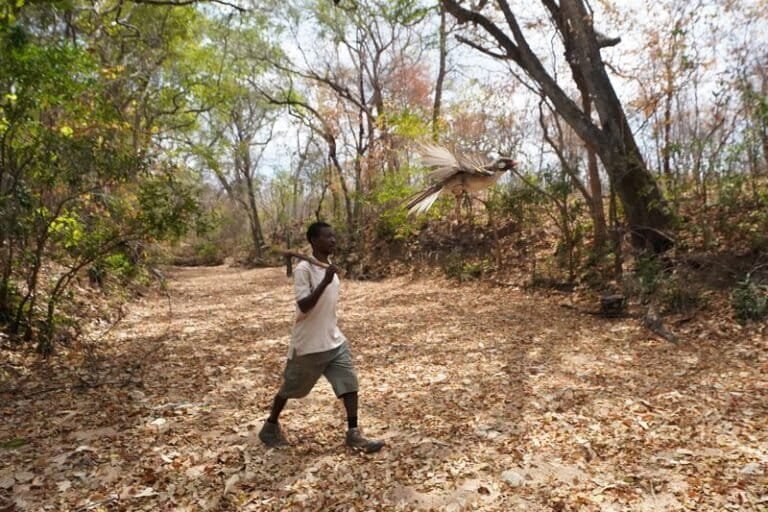
A Rare Interspecies Alliance Thrives (Image Credits: Imgs.mongabay.com)
Northern Mozambique’s Niassa Special Reserve – Researchers uncovered how honey-hunters and greater honeyguide birds sustained their partnership through regionally distinct vocal signals that mirrored human dialects.[1][2]
A Rare Interspecies Alliance Thrives
Greater honeyguides led Yao honey-hunters to hard-to-find bees’ nests, providing humans with honey while securing wax and larvae for themselves. This mutualism stood out as one of few known cases between people and undomesticated wild animals. Hunters wielded fire and tools to access nests, leaving scraps for the birds. The partnership persisted across sub-Saharan Africa but faced scrutiny in northern Mozambique’s vast 42,000-square-kilometer reserve.[3]
Honeyguides offered a bird’s-eye advantage in spotting hives. Hunters relied on them heavily for harvests. The birds responded to specific calls without training, highlighting learned behaviors on both sides. Earlier studies revealed cross-cultural differences, such as Yao trills versus Tanzanian whistles, but new work delved into finer regional patterns.[2]
Calls Vary Like Village Dialects
Honey-hunters employed trills, grunts, whoops, and whistles in three main categories. Long-range recruitment calls drew birds from afar, while short-range and coordination signals maintained contact during the pursuit. Recordings captured these nuances across 13 villages spanning up to 276 kilometers.[1]
Dissimilarities grew predictably with distance between communities. Villages farther apart featured more divergent signals, forming clusters akin to linguistic dialects. Examples included shrill “ooh” whoops or “brr-hm” grunt-trill combos. Immigrants quickly conformed to their new village’s style, ensuring seamless integration.[3]
- Long-range recruitment: Whistles and whoops for initial attraction.
- Short-range recruitment: Grunts and trills to close the gap.
- Coordination: Mixed trills, grunts, and whistles en route to nests.
Culture Shapes Signals, Not Habitat
Analyses ruled out environmental acoustics as the driver. Call differences held steady regardless of vegetation density or sound propagation factors. Social learning dominated, with hunters adopting proven local variants for better yields. Lead author Jessica van der Wal noted, “These regional honey-hunting calls pattern across space in a way that looks remarkably similar to human dialects.”[2]
Teams gathered 1,157 coordination call samples from 131 hunters in June 2019. Statistical models confirmed spatial distance as the key predictor. This cultural evolution reinforced effective communication within communities.
Both Species Flexibly Adapt
Honeyguides cooperated reliably despite dialect shifts, likely by learning village-specific cues within their limited territories. Prior playback tests showed birds favored familiar signals over foreign ones. Senior author Claire Spottiswoode observed, “Humans learn and maintain the local signals needed to cooperate with honeyguides, and honeyguides are in turn probably learning and so helping to maintain these dialects.”[2]
The study, published in People and Nature, illuminated interspecies dynamics.Read the full paper. Mutual flexibility preserved the bond amid cultural diversity.
Key Takeaways
- Honey-hunters’ calls formed dialects varying by village distance, driven by social factors.
- Immigrants adopted local signals, prioritizing success over origin styles.
- Honeyguides learned regional cues, enabling consistent cooperation across Niassa.
This evolving dialogue between humans and wild birds offered insights into communication’s adaptability. As dialects drifted over generations, the partnership endured, blending culture and instinct. What do you think about this human-wildlife synergy? Tell us in the comments.


