
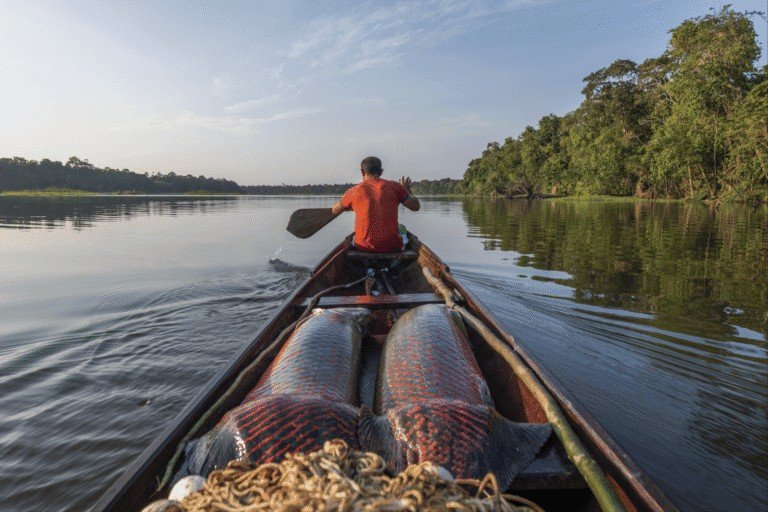
Round-the-Clock Patrols Secure Precious Waters (Image Credits: Imgs.mongabay.com)
Brazilian Amazon — Fisher families along the meandering Juruá River perched in wooden watchtowers over oxbow lakes, vigilantly warding off poachers targeting the giant pirarucu fish.
Round-the-Clock Patrols Secure Precious Waters
Rural communities near this Amazon tributary organized shifts to monitor lake entrances, especially during the dry season when water levels dropped and fish congregated.[1]
Residents confiscated illegal gear and alerted authorities, drawing on deep local knowledge to enforce rules. This collective effort formed the backbone of the largest community-based fisheries initiative in the Amazon Basin. Researchers examined 14 such groups overseeing 96 lakes, revealing protections that rippled far beyond the water’s edge.[1]
The Juruá’s sinuous path through floodplains created ideal habitats for pirarucu, or Arapaima gigas, the region’s largest freshwater fish and a key food source. Guards faced risks from confrontations while covering their own patrol expenses.
Protections Extend Deep into Forests and Floodplains
A study published in Nature Sustainability quantified the scale: patrols shielded floodplains nearly eight times larger than the lakes themselves.[1]
During rainy seasons, pirarucu migrations into flooded forests amplified coverage to 36 times the lake areas. Indirect safeguards reached upland forests, roughly 40 times larger. Overall, each community conserved a mean expanse 86 times the lakes’ size, linking aquatic and terrestrial ecosystems.
“Initial evidence suggests that community protection of aquatic environments for pirarucu management generates positive ecological effects that extend to terrestrial ecosystems,” co-author Ana Carla Rodrigues noted.[1]
- Direct lake monitoring year-round, intensified in dry periods.
- Floodplain barriers deterred outsiders across vast zones.
- Upland forest benefits from reduced encroachment.
- Total impact: millions of hectares under effective stewardship.
Pirarucu Recovery Fuels Biodiversity and Livelihoods
Stewardship reversed pirarucu declines, boosting populations by 425% since the early 2000s. Traditional counting methods, attuned to the fish’s air-breathing habits, ensured sustainable harvests.[1]
These apex predators, reaching 3 meters and hundreds of pounds, structured food webs and enhanced lake biodiversity. Harvest revenues funded community infrastructure and health needs, fostering stability.
Women gained prominence, mastering counts and leadership roles previously male-dominated. Youth participation curbed urban migration, building intergenerational commitment. “To build a brighter future for the Amazon, we need to have conventional science and traditional knowledge together at the same table,” said João Campos-Silva of the Juruá Institute.[1]
Unpaid Labor Reveals the Human Toll
Success relied on volunteers forgoing wages, meals, and family time. Surveillance consumed 32% of management costs and slashed incomes by 21%.[1]
Average protection ran $0.95 per hectare annually with unpaid work. Paid scenarios escalated figures:
| Scenario | Cost per Hectare/Year |
|---|---|
| Unpaid Labor | $0.95 |
| Local Daily Wages (2 Guards) | $5.30 |
| Brazil Minimum Wage | $5.40 |
Low-income households shouldered these burdens amid poacher threats. Experts urged payments for ecosystem services to sustain efforts.
Community-led models proved ecosystems thrived under local hands, yet demanded recognition through funding. Pilots at COP30 in Belém explored equitable payments, prioritizing transparency.
Key Takeaways
- 86-fold expansion in protected areas via patrols.
- 425% pirarucu rebound supports food security.
- Financial incentives essential for long-term viability.
These front-line defenders deserve rewards for safeguarding global benefits. What steps should governments take next? Share your thoughts in the comments.


