
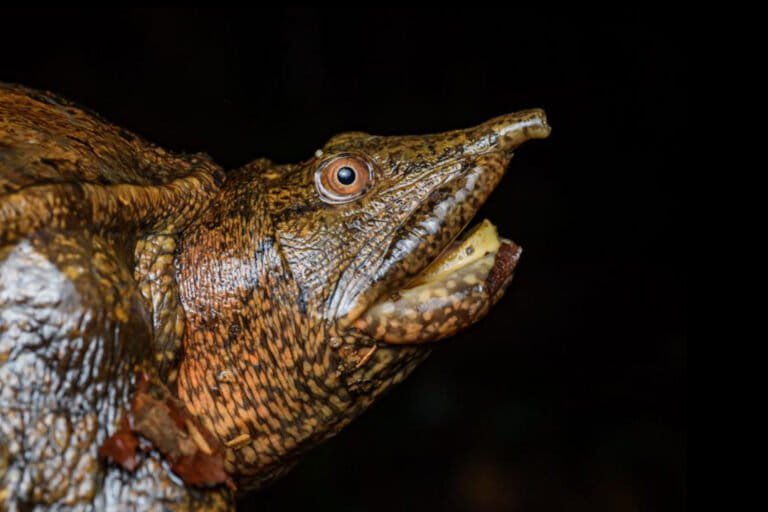
Ancient Reptiles Under Siege (Image Credits: Imgs.mongabay.com)
Indonesia – Researchers have challenged the assertion that the nation’s legal freshwater turtle harvest provides meaningful economic support to collectors, revealing stark limitations in its impact on livelihoods.
Ancient Reptiles Under Siege
Turtles and tortoises boast an evolutionary legacy exceeding 200 million years, surviving cataclysmic events that doomed dinosaurs. Yet Southeast Asia witnessed a sharp decline in chelonian populations around 2000, igniting the so-called Asian turtle crisis.[1][2]
A burgeoning middle class in China fueled demand for turtle meat, transforming it from luxury to everyday fare. Habitat loss and pollution compounded the pressure. More than half of global tortoise and turtle species now teeter on the brink of extinction. Indonesia, home to 39 turtle species, emerged as a key exporter amid this turmoil.[1]
Quotas Define a Contested Harvest
Authorities permit nearly 50,000 freshwater turtles annually across 27 provinces, targeting four regulated species under CITES: the vulnerable Asiatic softshell turtle (Amyda cartilaginea), endangered Southeast Asian box turtle (Cuora amboinensis), and near-threatened Asian leaf turtle (Cyclemys dentata) and Malayan softshell turtle (Dogania subplana).[1][2][3]
Most head to China for meat, with collectors requiring licenses and provinces setting local quotas. Average annual allowances break down as follows: 26,350 Asiatic softshells, 12,000 Malayan softshells, 9,035 box turtles, and 2,100 leaf turtles. Market prices for collectors range from $1.10 to $20 per turtle. Despite regulations, populations continue to dwindle due to slow reproduction rates.
- Asiatic softshell turtle: Largest quota, vulnerable status.
- Southeast Asian box turtle: Endangered, recent subspecies splits including critically endangered forms.
- Asian leaf turtle: Omnivorous scavenger in freshwater systems.
- Malayan softshell turtle: Common in trade visuals but quota-constrained.
Limited Economic Footprint Exposed
A study by Vincent Nijman of Oxford Brookes University and Chris R. Shepherd of the Monitor Conservation Research Society calculated potential incomes from quotas between 2016 and 2022. Legal trade could sustain just 241 to 360 collectors at minimum wage nationwide, or 0 to 41 per province, before deducting costs like permits and gear.[1][2]
At 1.5 times minimum wage for a livable income, that drops to 161-204 individuals. Nijman noted, “We were looking for some support for the idea that, indeed, wildlife trade contributes to livelihoods.” Even sporadic contributions – 10% of minimum wage – might aid 2,410-3,060 people, mere “cigarette money” at $11.50-$20 monthly in a nation of 285 million.[1][3]
| Province | Collectors at Min. Wage | Population (millions) |
|---|---|---|
| East/North Kalimantan | 41 | 4.4 |
| North Sumatra | 36 | 14.8 |
| Riau Islands | 30 | 9.2 |
| Seven provinces | 0-2 | Varies |
Unsustainability Overshadows Gains
Shepherd emphasized, “Wild-caught turtle trade is not sustainable, and therefore it doesn’t make sense to promote it as a livelihood issue.” Illegal trade, potentially 90% of volume for some species, might boost beneficiaries to 1,500-3,000, or 5-10 per million inhabitants. These reptiles serve vital ecological roles as scavengers, cleansing waterways of carrion.
Experts call for stricter quota enforcement, bans on threatened species like the Palu box turtle subspecies, and alternative income sources. Promoting the trade risks accelerating declines without broad economic uplift. Authorities must prioritize conservation over unsubstantiated livelihood defenses.
- Legal quotas support fewer than 360 collectors at minimum wage, excluding costs.
- Trade volumes average 50,000 turtles yearly across four imperiled species.
- Unsustainable harvest threatens biodiversity; alternatives needed for rural economies.
Indonesia’s turtle trade underscores a broader tension: fleeting economic scraps versus enduring ecological costs. Policymakers face a clear choice – curb the harvest to safeguard species or perpetuate a system that benefits few at nature’s expense. What do you think about balancing trade and conservation? Tell us in the comments.


