
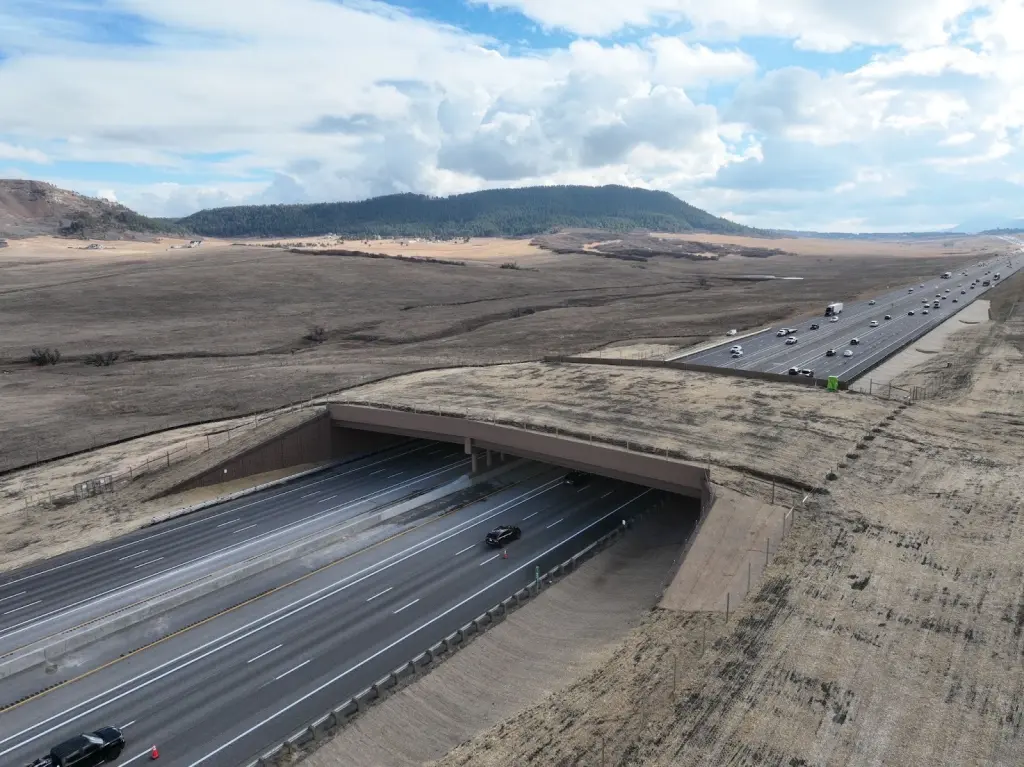
Greenland, Colorado – Construction crews completed North America’s largest wildlife overpass in December 2025, spanning six lanes of Interstate 25 in this Douglas County community between Larkspur and Monument. The structure addresses a persistent problem in one of the state’s busiest corridors, where more than 100,000 vehicles pass daily.[1][2] Officials hailed the project as a milestone that reconnects fragmented habitats and promises significant reductions in dangerous encounters between drivers and animals.
A Highway Hotspot for Collisions
Before the overpass opened, this stretch of I-25 averaged one wildlife-vehicle crash per day during peak migration seasons in fall and spring. Elk, mule deer, and pronghorn frequently attempted to cross the interstate, leading to hazardous situations for motorists and animals alike. The corridor bisected critical habitats, forcing large mammals into risky paths amid heavy traffic.[2][3]
State data highlighted the severity: from 2011 to 2015, 785 such incidents occurred in the area, accounting for 6% of all crashes annually. Nationally, wildlife-vehicle collisions claim lives and cause billions in damages each year. Colorado officials prioritized this site due to its role in major migration routes linking open spaces on the Front Range.[4]
Engineering the Continent’s Biggest Crossing
The I-25 Greenland Wildlife Overpass measures 200 feet wide by 209 feet long, covering nearly an acre with 76 supporting girders and gently sloped entrances to encourage use. Big game animals prefer such open designs over enclosed underpasses, as they offer clear sight lines and natural approaches. Contractors finished the $15 million project ahead of schedule and under budget, freeing funds for additional fencing.[2][1]
Federal grants from the U.S. Department of Transportation’s Wildlife Crossing Pilot Program covered much of the cost, supporting one of 19 such initiatives nationwide. The overpass caps a multi-year effort involving the Colorado Department of Transportation, Colorado Parks and Wildlife, Douglas County, and other partners. CDOT Executive Director Shoshana Lew described it as “critical to the safety of both wildlife and motorists.”[1]
Reuniting Habitats Across the Divide
The structure links 39,000 acres of preserved land on either side of I-25, connecting Douglas County open spaces to over a million acres in Pike National Forest. This reconnection supports east-west movements essential for elk herds, pronghorn, black bears, mountain lions, moose, and smaller species like coyotes and raccoons. It fills a 3.7-mile gap in an existing network of five underpasses and 28 miles of exclusionary fencing.[2][4]
Part of the broader $419 million I-25 South Gap project, the overpass enhances an 18-mile corridor from Castle Rock to Monument. Underpasses in the system have already logged thousands of crossings by mule deer since implementation. Early observations post-opening included moose at the entrance and activity from elk and bears, signaling growing adoption despite a mild winter delaying migrations.[3][5]
Expected Impact and Broader Lessons
Project leaders anticipate a 90% drop in wildlife-vehicle crashes along this corridor, mirroring successes elsewhere in Colorado where crossings have slashed incidents by 80% to 90%. The full system guides animals to safe passages, minimizing road exposure. Douglas County Commissioner George Teal emphasized the long-term stewardship: partnerships dating to 1996 have preserved vital migration paths amid urban growth.[1]
- Targets large mammals avoiding tunnels, like elk and pronghorn.
- Integrates with fencing to funnel wildlife effectively.
- Supports diverse species, from bears to badgers.
- Boosts motorist safety on a high-traffic route.
- Demonstrates scalable model for U.S. highways.
| Feature | Details |
|---|---|
| Pre-Overpass Crashes | 1 per day (peak seasons)[2] |
| Expected Reduction | 90%[1] |
| Daily Traffic | 100,000+ vehicles[3] |
- The overpass reconnects fragmented habitats, vital for Front Range wildlife.
- It promises dramatic safety gains, backed by proven crossing networks.
- Multi-agency collaboration sets a national example for infrastructure.
Governor Jared Polis called the overpass a “momentous feat” in protecting habitats for generations. As usage ramps up, this engineering marvel stands as a blueprint for balancing human progress with nature’s needs. What do you think about these wildlife crossings? Tell us in the comments.


