
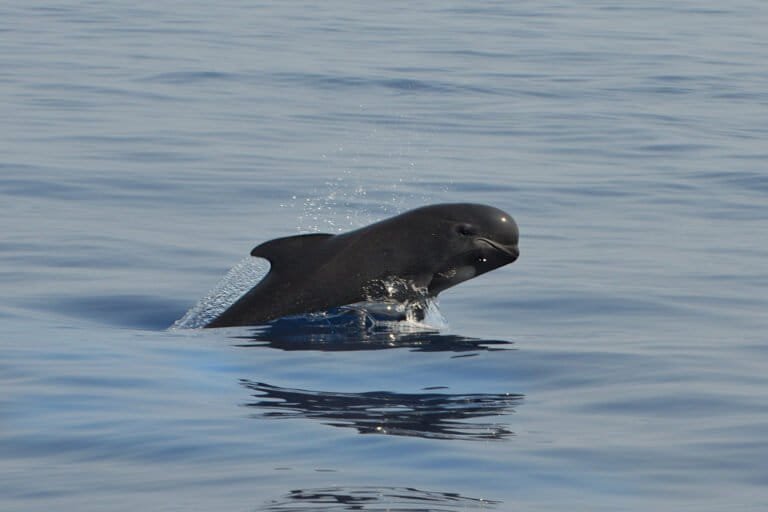
Organofluorine Levels Peaked Then Plummeted (Image Credits: Imgs.mongabay.com)
North Atlantic – Harvard researchers documented a more than 60% drop in concentrations of legacy PFAS chemicals in pilot whale tissues over the past decade, providing evidence that phase-out efforts have reached even remote ocean ecosystems.[1][2]
Organofluorine Levels Peaked Then Plummeted
Extractable organofluorine concentrations, a proxy for total PFAS burden, reached their highest point in pilot whale livers around 2011 before falling sharply.[1] This peak occurred roughly a decade after major manufacturers began phasing out problematic long-chain PFAS in the early 2000s. By 2023, levels had declined by over 60% from that high.
Targeted analysis identified four legacy compounds – PFOS, FOSA, and two long-chain PFCAs – as responsible for more than 75% of the organofluorine detected across the study period.[1] Each showed significant decreases post-peak. For instance, PFOS concentrations in tissues dropped 11% to 29% annually after peaking between 2017 and 2020.
Pilot Whales Serve as Key Pollution Indicators
North Atlantic long-finned pilot whales act as ideal sentinels for marine contamination. These apex predators forage at depths of 400 to 700 meters on squid and fish, accumulating chemicals over long periods in their remote pelagic habitat.[2]
Researchers analyzed archived liver and muscle samples from juvenile males collected in the Faroe Islands between 1986 and 2023. This long-term dataset, maintained by local agencies, allowed precise tracking of trends while minimizing variability from age, sex, or location.[3] Advanced techniques like combustion ion chromatography measured bulk organofluorine, capturing both known and unknown PFAS.
Legacy Chemicals Fade, but Replacements Emerge
Legacy PFAS dominated the contamination profile throughout the record. FOSA, a precursor to PFOS, declined steadily from the early 2000s, while C10 PFCAs peaked in 2013-2016 before falling 13% to 17% per year.[1]
However, one replacement chemical – C4 FASA, used in semiconductor production – rose about 7% annually from 2001 to 2023. Screening for 16 other suspects revealed mostly downward trends. Lead author Jennifer Sun noted, “Production phase-outs, which were initially voluntary and later driven by regulation, have been quite effective at reducing concentrations of these chemicals in near-source communities as well as more remote ecosystems.”[2]
- PFOS (C8 PFSA): Peaked 2017-2020, then rapid decline.
- FOSA (C8 FASA): Monotonic decrease since 2000s.
- C10/C12 PFCAs: Declined post-2013 peaks.
- C4 FASA: Consistent increase amid replacements.
Implications for Ocean Health and Policy
Ocean modeling explained the decade-long lag: chemicals produced near coasts take years to transport to deep foraging grounds. Senior author Elsie Sunderland observed, “While our results are good news for ocean contamination, it suggests newer PFAS may behave differently from the legacy ones.”[2]
Unlike trends in human blood, where total organofluorine remains stable or rises, open-ocean declines highlight how regulations curb distant exposures. Yet the rise of short-chain alternatives underscores risks of regrettable substitutions.
| Chemical Group | Trend (Post-Peak) | Annual Change |
|---|---|---|
| Legacy PFAS (e.g., PFOS, FOSA) | Declining | 11-29% |
| C10/C12 PFCAs | Declining | 13-17% |
| C4 FASA (Replacement) | Increasing | +7% |
Key Takeaways
- Regulations phased out legacy PFAS effectively, cutting ocean levels by over 60%.
- Pilot whales confirm remote ecosystems benefit from global action.
- Monitor emerging replacements like C4 FASA to prevent new threats.
These findings affirm that persistent pollutants can recede with sustained policy pressure, though vigilance against innovations remains essential. What steps should regulators take next to address replacement chemicals? Share your thoughts in the comments.


