
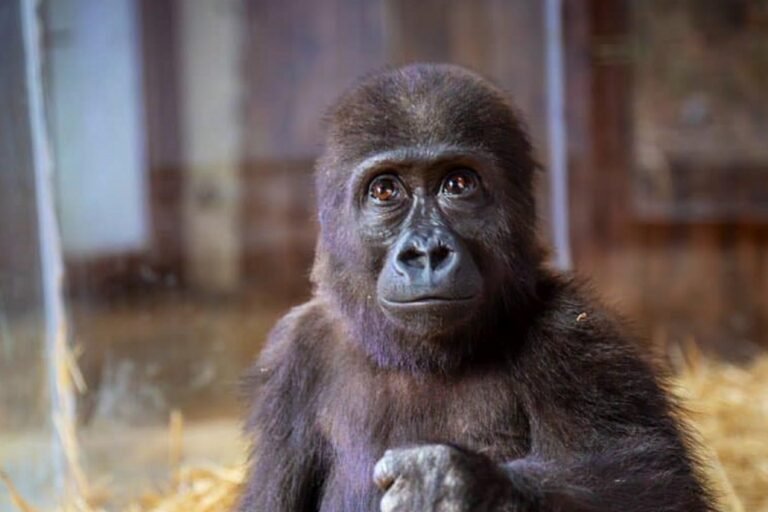
Hidden in Plain Sight at Istanbul Airport (Image Credits: Imgs.mongabay.com)
Istanbul – A critically endangered western lowland gorilla rescued from smugglers in late 2024 continues to live alone in a cage at Polonezköy Zoo, prompting urgent calls from conservationists for his relocation to Africa.[1]
Hidden in Plain Sight at Istanbul Airport
Turkish customs officers uncovered a heartbreaking sight on December 22, 2024. A malnourished 5-month-old male gorilla huddled inside a wooden crate in the cargo hold of a flight transiting from Nigeria to Bangkok. The crate bore a false label claiming it held 50 rabbits, and the infant wore a soiled T-shirt.[1]
Officials determined the primate had no export permits or documentation, violating CITES regulations that ban commercial trade in great apes. The discovery highlighted the brutal reality of wildlife trafficking, where infants like this one are often orphaned after poachers kill their mothers.[1]
Authorities quickly seized the gorilla and transferred him to Polonezköy Zoo for immediate care. There, veterinarians began nursing him back to health amid global media attention.[2]
Public Embrace and Initial Recovery
The Turkish Ministry of Agriculture and Forestry launched a social media campaign to name the young gorilla. Citizens responded enthusiastically, selecting “Zeytin,” Turkish for “olive,” after a public poll.[1]
Under the care of the Nature Conservation and National Parks Directorate, Zeytin gained weight and stabilized. Officials shared updates, including photos showing his progress, and emphasized their commitment to his well-being.[2]
Early statements promised repatriation to an African sanctuary, possibly Nigeria’s Drill Ranch, a facility accredited by the Pan African Sanctuary Alliance (PASA). In August 2025, Kadir Çokçetin, the directorate’s general director, announced negotiations were in the final phase, with Turkish Airlines ready to transport him.[1]
DNA Test Alters Fate
Momentum shifted in October 2025 following DNA analysis. Whole genome sequencing revealed Zeytin as a western lowland gorilla not native to Nigeria, his transit origin. Turkish officials cited international rules and decided he would stay permanently in a zoo.[3][1]
“Since Nigeria is not the country of origin, it was decided to place Zeytin in a zoo in Turkey,” the Nature Conservation and National Parks Directorate stated.[3]
No traffickers faced arrest, leaving his exact origins – likely the Congo Basin or nearby – unknown. As of February 2026, Turkish authorities provided no further updates on his status.[1]
Conservationists Sound Alarm
Experts warn that Zeytin’s solitary confinement dooms his future. Gorillas thrive in family groups, forming deep social bonds essential for psychological health.[1]
- Aslıhan Niksarlı of the Jane Goodall Institute Türkiye noted: “Türkiye does not have adequate facilities to meet the long-term physical, social and psychological needs of a gorilla. Zeytin continues to live in isolation.”
- Jacqueline L. Sunderland-Groves of the IUCN great apes group added: “Zeytin’s current situation provides no opportunity to live with other western lowland gorillas. It is never recommended to keep a gorilla alone in captivity.”
- Iris Ho of PASA stressed: “Solitary captivity indefinitely rules out any chance at reintroduction.”
These voices echo at forums like the CITES meeting in Uzbekistan, where Zeytin’s case underscored enforcement gaps in great ape trafficking.[1][4]
Key Takeaways
- Zeytin’s isolation prevents socialization vital for gorillas.
- African sanctuaries offer better rehabilitation prospects.
- Repatriation aligns with CITES best practices for trafficked wildlife.
Zeytin’s story reveals the challenges of rescuing trafficked wildlife: swift action saves lives, but long-term solutions demand international cooperation. Conservation groups urge Turkey to reconsider, prioritizing his natural needs over zoo display. What steps should governments take to combat ape trafficking? Share your thoughts in the comments.


