
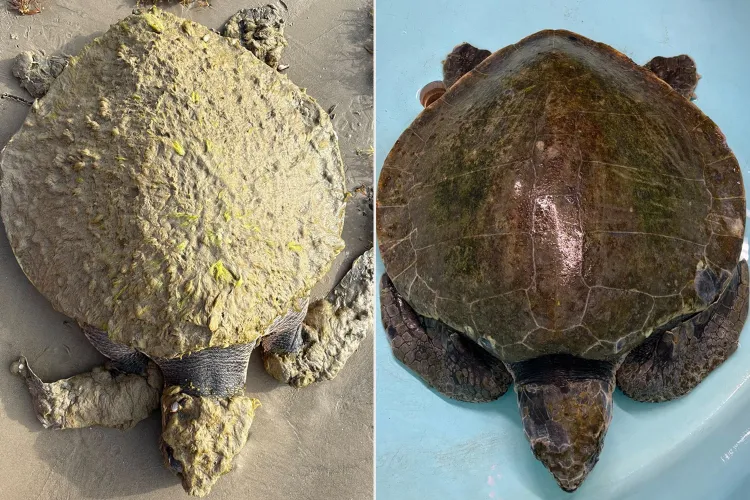
Galveston, Texas – An adult female Kemp’s ridley sea turtle washed ashore near Beach Pocket Park #3 on March 7, drawing immediate attention from conservationists.[1][2] The creature, lethargic and encrusted with barnacles, algae, and sediment, faced a life-threatening condition that highlighted the vulnerabilities of this critically endangered species.[3] Rescue teams from the Gulf Center for Sea Turtle Research responded quickly after a hotline call, transporting her for urgent care.[4]
A Shocking Sight on the Shoreline
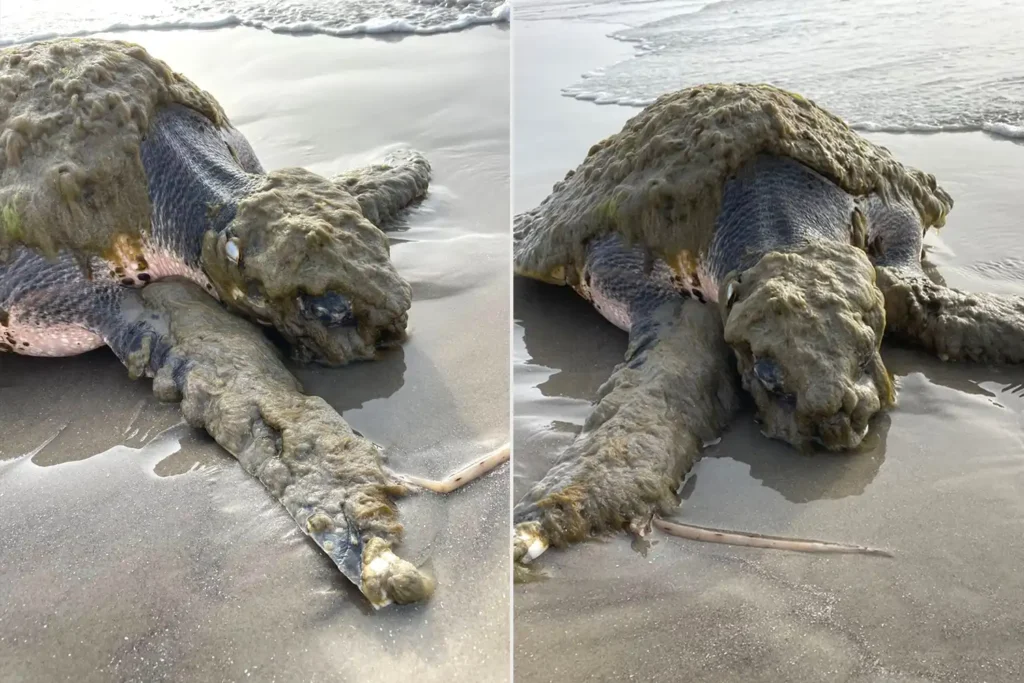
The turtle’s appearance stunned responders. Her shell and body bore a heavy load of epibionts – marine organisms that thrive on weakened hosts – resembling a coat of green fur in some descriptions.[3] This buildup often signals prolonged illness, as healthy sea turtles swim vigorously enough to prevent such colonization.
Christopher Marshall, director of the Gulf Center for Sea Turtle Research, described the scene: “When our responders got there, we determined that it was alive, but it was in a really bad shape.”[2] A beachgoer had spotted the stranded animal early that morning and dialed the Texas statewide sea turtle hotline at 1-866-TURTLE-5, enabling the rapid intervention.[1] The team assessed her on-site and confirmed she needed immediate medical attention.
The Downward Spiral of Sickness
Illness creates a vicious cycle for sea turtles. As the Kemp’s ridley slowed due to her ailments, epibionts attached and multiplied, adding weight that further impaired her mobility and drained her energy.[5] Marshall noted, “Healthy sea turtles are swimming sea turtles. Sea turtles that slow down their swimming due to health issues are quickly colonized by organisms in the water. This can turn into a positive feedback loop.”[1]
Medical evaluations later revealed severe pneumonia and related ocular ulcers. These conditions likely stemmed from her weakened state, compounded by the Gulf’s environmental pressures. Responders cleaned her shell during initial treatment, revealing a smooth surface beneath the overgrowth.[3]
Intensive Rehabilitation Underway
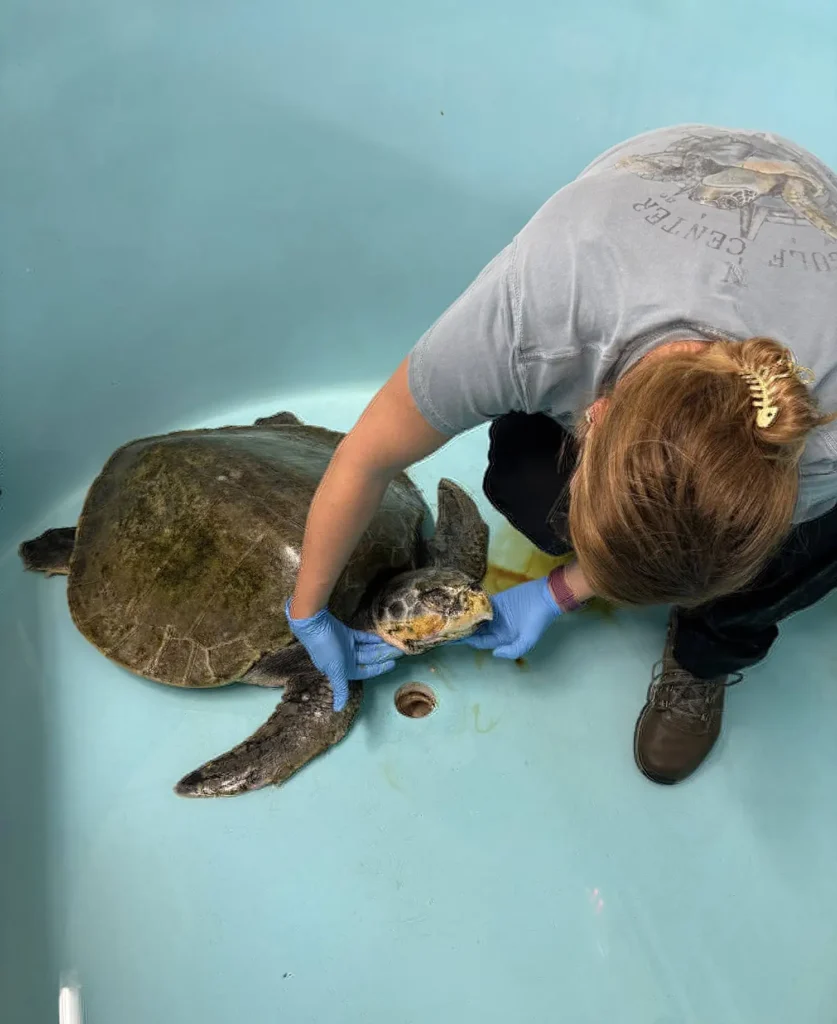
The turtle received an emergency evaluation at the Houston Zoo, where veterinarians diagnosed her critical state and initiated care.[4] She then moved to the Gulf Center for Sea Turtle Research’s rehabilitation hospital for ongoing treatment, including antibiotics, pain medication, and supportive therapies.
Daily routines involve tank cleaning, feeding, and twice-daily behavioral assessments. Staff and volunteers dote on her, monitoring every sign of progress. Marshall reported early improvements: “We’ve put her back into some water and she’s moving around and she’s starting to show a little more energy.”[2] The center’s team remains optimistic, though her recovery demands patience and precision.
Spotlight on a Precarious Species
Kemp’s ridley sea turtles represent the world’s smallest and most endangered sea turtle population, with only about 22,300 mature adults estimated globally.[3] Native to Gulf waters and Texas’s official state turtle, they face threats from habitat loss, fishing gear, boat strikes, and debris. Nests appear primarily along the western Gulf, with Texas hosting key sites like Padre Island National Seashore.
Conservation efforts have boosted numbers from near extinction, but each individual counts. As Marshall emphasized, “We always take extra care for our sea turtles, but this particular patient is really valuable to the population.”[2] The Gulf Center for Sea Turtle Research plays a vital role, handling strandings year-round through donations and volunteers.
Rescues like this one underscore the importance of public vigilance. Bystanders who spot stranded turtles should call the hotline rather than intervene directly, ensuring professional handling.
Key Takeaways
This turtle’s journey from Galveston sands to a rehab tub offers hope amid challenges. With dedicated care, she may soon swim free again, bolstering her fragile species. What do you think about these conservation efforts? Tell us in the comments.


