
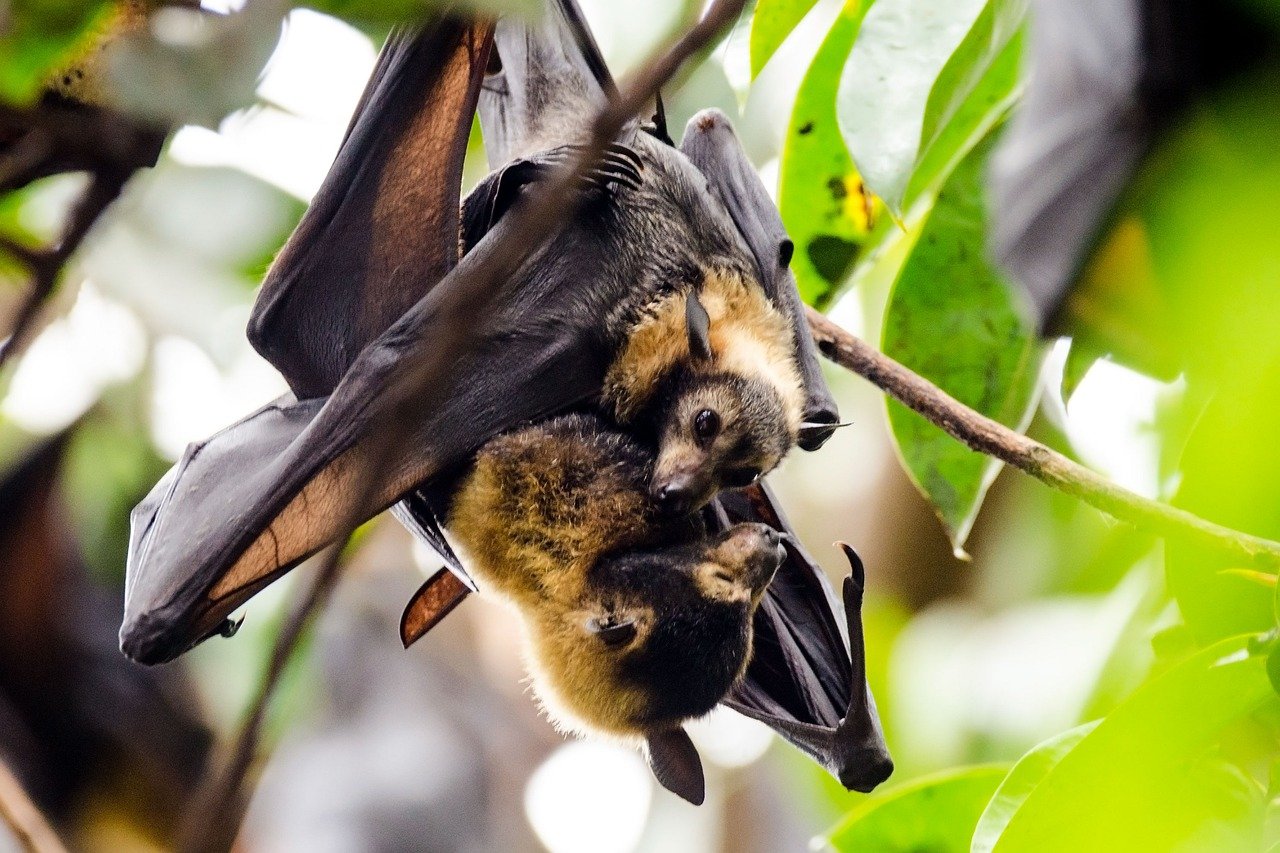
Australia – Flying foxes, the large fruit bats native to the continent, sustain vast forests and bolster economic sectors through their pollination and seed dispersal. A recent study published in Scientific Reports quantified these contributions for the first time, mapping the bats’ influence across millions of hectares.[1][2] Researchers highlighted the grey-headed flying fox’s role in regenerating trees essential to the eucalypt timber trade, challenging the animals’ image as mere pests.
Unmapped Influence Comes into Focus
Scientists analyzed data from the CSIRO National Flying-Fox Monitoring Program spanning 2012 to 2022. They identified 1,209 roosts belonging to four mainland flying fox species.[1] By applying species-specific foraging distances of 3 to 50 kilometers, the team calculated the “Bat Ripple” – the collective foraging footprint – covering 11.6 to 41.4 million hectares. This area rivals the size of Sweden and includes forests, plantations, and restoration zones.
The grey-headed flying fox emerged as a standout. With 465 roosts and a population of about 578,350 individuals, these bats facilitate the growth of a median 91.6 million new trees each year across their maximum range.[1] Such regeneration underpins native ecosystems and commercial forestry alike.
Economic Valuation Puts Bats in the Billions
The study employed Monte Carlo simulations to estimate pollination services specifically for the eucalypt timber industry. Grey-headed flying foxes overlap with 36,038 square kilometers of timber habitat, delivering a median annual value of AUD $611 million.[1] The 90% uncertainty range spans AUD $271 million to $955 million, based on pollination dependency ratios and per-hectare timber values.
| Metric | Median Value (AUD) | Range (90% UI, AUD) |
|---|---|---|
| Pollination to Eucalypt Timber | $611 million/year | $271–955 million/year |
| Tree Recruitment (Max Range) | 91.6 million trees/year | 20.4–378.2 million trees/year |
These figures represent conservative estimates. They exclude contributions from other species, seed dispersal beyond figs, and ancillary benefits like pest control or guano fertilization.[1] Sensitivity tests confirmed robustness, with values holding in the hundreds of millions even under adjusted assumptions.
From Pests to Providers: Shifting Perceptions
Flying foxes often face backlash for roosting in urban areas, where they are labeled noisy and messy. Yet their long-distance flights – up to 50 kilometers nightly – outpace birds in spreading pollen and seeds. “There is no bird that can move the distance, on average, that a flying fox can move in a night,” noted University of Sydney scientist Alfredo Ortega González.[2]
Public views contrast sharply with their ecological weight. The study authors stressed that these bats sustain forest productivity amid climate pressures, including heatwaves that have killed tens of thousands in single events.[2] Extreme weather and megafires exacerbate declines, particularly for the endangered spectacled flying fox.
Urgent Need for Protection
Population losses threaten the Bat Ripple effect. Since 1994, at least 34 mass mortality events from heat stress have occurred, with some colonies losing over 80% of individuals. Conservation measures must prioritize roost protection and habitat connectivity.
- Enhance monitoring via CSIRO programs.
- Reduce urban conflicts through non-lethal deterrents.
- Integrate bat services into forestry management plans.
- Address climate vulnerabilities with shaded refuges.
- Promote public education on their economic role.
“Our estimates likely represent a conservative lower bound of the true value flying foxes bring to Australian landscapes,” the researchers concluded in the Scientific Reports paper.[1] Protecting these keystone species ensures long-term forest health and industry viability.
As Australia grapples with environmental shifts, the flying foxes’ contributions remind policymakers of nature’s economic intertwinedness. Their potential loss could ripple through ecosystems and markets alike. What steps should follow to safeguard these vital bats? Share your thoughts in the comments.
Key Takeaways
- Flying foxes influence 11.6–41.4 million hectares, regenerating up to 91.6 million trees yearly.
- Pollination alone values at AUD $271–955 million annually for eucalypt timber.
- Conservation counters threats like heat stress, preserving both biodiversity and economic gains.


