
They Feel What You Feel, Literally

Dogs don’t simply notice that something is off with you. Research shows that their stress responses actually mirror yours at a biological level. The stress levels in dogs and their owners follow each other, with scientists concluding that dogs mirror their owner’s stress level. This isn’t anecdotal. It shows up in measurable cortisol concentrations.
In both summer and winter samples, cortisol levels from dogs were “synchronized” with their owners, marking the first study to identify long-term synchronization in stress levels between members of two different species. So when you’re moving through weeks of emotional turmoil during a divorce, your dog isn’t just observing your pain from the outside.
Studies show that behavioral and chemical cues from humans can affect dogs in ways that enable them to not only discriminate between their owners’ fear, excitement, or anger, but also to “catch” these feelings from their human companions. The bond runs deeper than most people realize, closer to emotional synchrony than simple companionship.
They Read You Without a Single Word Being Spoken
Through their remarkable ability to sense our emotions, dogs pay close attention to our body language, facial expressions, tone of voice, and even our scent, and this deep sensitivity allows them to recognize when we’re stressed, sad, or afraid. During a divorce, when so much goes unsaid, this ability becomes something close to essential.
There is also a scent component that most people never consider. The long-term cortisol level of pet dogs mirrors that of their owners, and this finding was unrelated to exertion or exercise, suggesting that the cortisol levels were a product of psychological rather than physical stress. Your dog is quite literally reading your internal chemistry.
Research has found that when dogs hear expressions of distress, like crying, they respond differently than they do to other vocalizations or non-human sounds. When you’re sitting on the bathroom floor at midnight during a divorce, crying quietly, your dog notices. Not out of habit. Out of something more deliberate than that.
They Choose to Come Closer, Not Pull Away
One of the most moving things dogs do is actively move toward distress, not away from it. A study published in the Animal Cognition journal states that dogs are more apt to walk up to a person who is crying than when that person is exhibiting normal, happy behaviors, and researchers concluded that a human crying had more of an emotional pull for the dogs, driven not by curiosity but by pure concern.
This distinction matters enormously. Dogs respond to the crying person’s need, not their own. What looks like a dog simply resting its head on your lap is actually an oriented, purposeful response to your emotional state. Dogs look at and approach their distressed owners, engaging in licking and nuzzling behavior, indicating that human emotional changes transmit to dogs and that dogs can recognize and react with an increased stress response of their own.
Dogs were as likely to rescue their distressed owner as to retrieve treats, indicating that helping an owner may be a highly rewarding action for dogs, and dogs released the owner more often when the owner called for help than when the owner read aloud calmly. The instinct to move toward you in your worst moments appears, from the evidence, to be genuine and not merely conditioned.
Their Presence Changes Your Brain Chemistry

The comfort a dog provides during a divorce is not purely emotional. It is also measurably physiological. Studies show that petting an animal for just fifteen minutes lowers cortisol, the stress hormone, while boosting oxytocin, the bonding hormone, creating a physiological counterbalance to the stress of heartbreak and grief.
When humans interact with a dog, both species release oxytocin and their cortisol levels drop, and for the grieving nervous system, which is often in a state of prolonged low-grade activation, this chemical response offers genuine, measurable relief. Divorce keeps the nervous system on a kind of constant low alert for weeks or months. A dog’s physical presence quietly, persistently walks it back from the edge.
There is also something deeper happening neurologically. Researchers found that when dogs and their owners engage in mutual eye contact, especially when combined with petting, their brain activity synchronizes, not metaphorically but literally: the neural oscillations of both human and dog begin to align. Simply looking into your dog’s eyes during one of the hardest seasons of your life is, in a very real sense, a shared experience.
They Quietly Rebuild Your Sense of Daily Life
Divorce dismantles routine, and routine is one of the first things the human mind reaches for when it’s trying to stabilize. Grief often disrupts daily structure, motivation drops, basic tasks can feel overwhelming, but dogs still need to be fed, walked, and cared for, and that responsibility gently encourages routine. It’s a soft but persistent pull back toward functioning.
Dogs, with their need for walks and play, naturally combat the isolation and inactivity that often accompany grief, their enthusiastic greetings and social nature create daily moments of joy that gradually counterbalance sorrow, and walking a dog often leads to social interactions, gently easing you back into connection when you want to withdraw. The structure they demand is the same structure that keeps a person from disappearing entirely into the fog.
Whether the loss is a loved one, a relationship, or a major life change, the emotional weight can be hard to carry alone, and during these moments dogs often become quiet but powerful sources of comfort, their presence not erasing pain but making the journey through grief feel less isolating. That last part deserves sitting with. Not erasing. Just making it less alone. For many people going through a divorce, that distinction is everything.
Conclusion
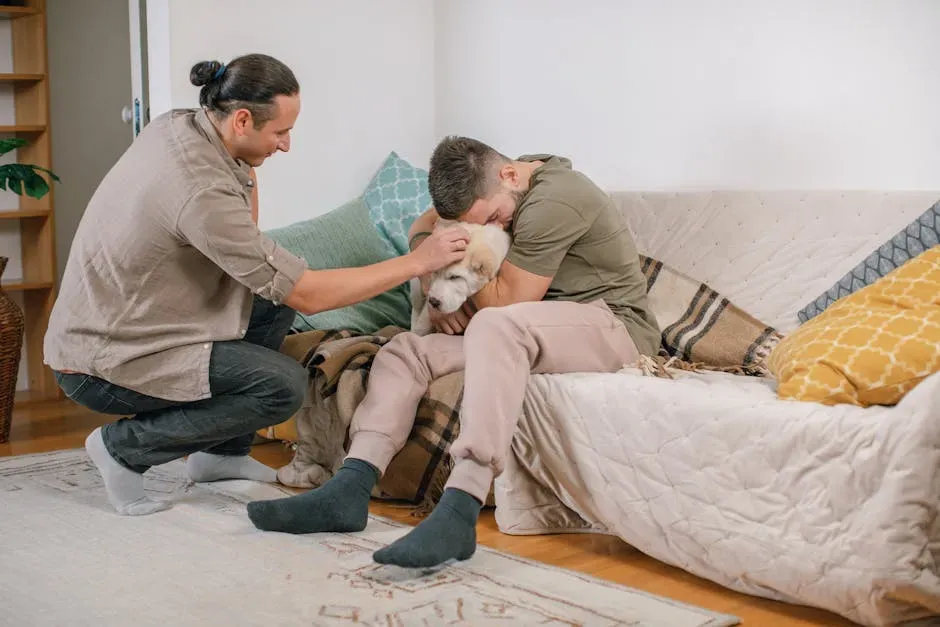
What dogs do when they sense you’re going through a divorce isn’t one dramatic gesture. It’s a hundred small, consistent ones. It’s staying close when everyone else keeps a careful distance. It’s responding to your crying with presence instead of advice. It’s offering a biological reset that no pill or productivity habit can quite replicate.
The science is clear enough to take seriously: dogs synchronize with our stress, move toward our distress, and physically help regulate the nervous systems we’ve thrown into chaos. They don’t require us to explain ourselves or perform recovery on anyone else’s timeline.
What makes this all so quietly stunning is that dogs don’t do any of it strategically. There is no calculation. They simply remain, warm and grounded and close, in precisely the place where you need someone to be. Sometimes, when words have run dry and human comfort falls short, the most healing thing in a room has four legs and fur, and it has already been sitting beside you this whole time.


