
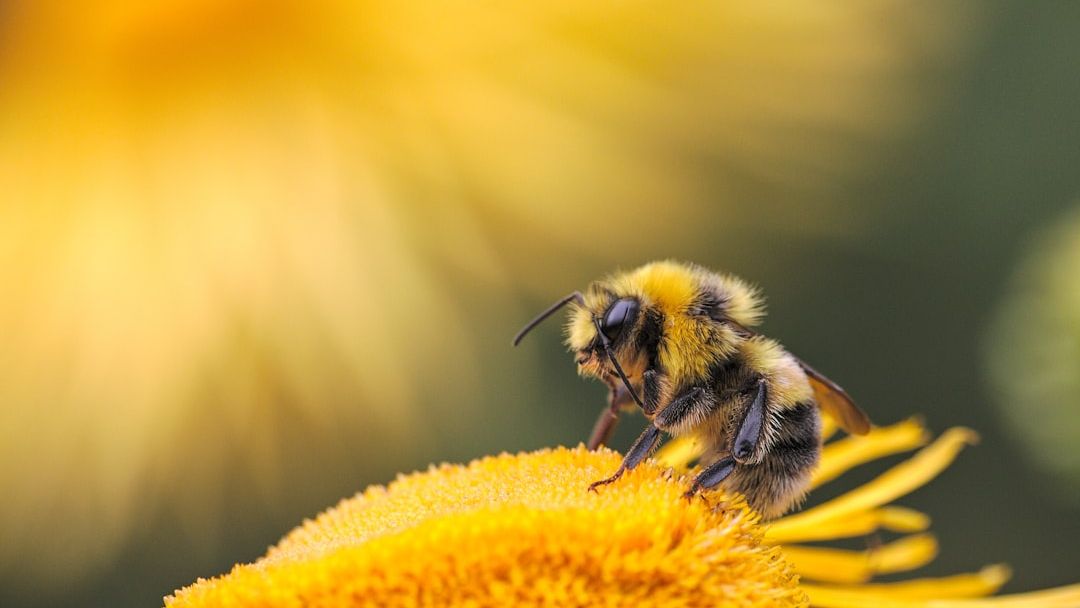
Bees found an unlikely new food source, and it could reshape how a destructive forest disease travels – Image for illustrative purposes only (Image credits: Unsplash)
In Australian woodlands, Western honey bees have begun collecting spores from myrtle rust, a fungus that has already damaged many native plants. The insects treat these spores as a food source, while the fungus gains a new way to move from one location to another. Researchers tracking this interaction now see signs that the two species may be helping each other spread more effectively than either could alone.
The Two Species at the Center of the Story
Western honey bees arrived in Australia more than a century ago and now live across much of the continent. Myrtle rust, caused by the fungus Austropuccinia psidii, reached the country more recently and quickly infected a wide range of trees and shrubs in the myrtle family. Both the bee and the fungus are considered introduced, yet their recent overlap has created an unexpected connection.
Scientists have long studied how invasive species interact with one another. In this case, the relationship appears to benefit both sides. The bees gain nutrition from the spores, and the fungus receives help moving to new plants through the bees’ foraging flights.
How the Partnership Works in Practice
Field observations and laboratory tests showed that bees actively visit rust-infected leaves and carry viable spores on their bodies. Once the spores reach a new host plant, the fungus can begin another infection cycle. This process gives the disease a mobile carrier that travels farther and faster than wind or rain alone would allow.
The same movement also supplies the bees with a steady supply of spores during times when other pollen or nectar sources are limited. Because the relationship improves the success of both organisms, researchers describe it as an example of invasional mutualism, a term used when two non-native species reinforce each other’s spread.
Early data suggest the pattern is most noticeable in areas where myrtle rust has already become established. In these locations, bee colonies appear to maintain higher activity levels near infected vegetation, creating a feedback loop that could accelerate the fungus’s reach into previously untouched forests.
What the Findings Mean for Native Ecosystems
Forest managers have already spent years trying to slow myrtle rust through pruning, chemical treatments, and public awareness campaigns. The new bee connection adds another layer of complexity. Any plan that ignores the role of pollinators may miss an important pathway for the disease.
At the same time, the discovery highlights how introduced species rarely act in isolation. A change in one part of the system, such as the arrival of a new food source for bees, can alter the behavior of an entire pathogen. This ripple effect may influence which native plants survive and which decline over the coming decades.
Questions That Still Need Answers
Researchers emphasize that the current evidence comes from a limited number of sites and seasons. It remains unclear how strongly the relationship holds in different climates or during years with heavy rainfall. Long-term studies will be needed to measure whether the fungus actually increases its infection rate because of bee activity or whether other factors play a larger role.
Another open issue involves the bees themselves. While the spores provide nutrition, scientists do not yet know whether repeated exposure affects bee health or colony strength. Continued monitoring will help separate short-term gains from possible longer-term costs.
What matters now
- Bees are carrying viable myrtle rust spores between plants.
- The interaction creates a two-way benefit that could speed disease spread.
- More field data are required before management plans can fully account for the new pathway.
Understanding this link between an introduced insect and an invasive fungus gives land managers one more piece of information as they work to protect Australia’s forests. The relationship is still being mapped, yet its existence already changes how the movement of myrtle rust is viewed. Future work will show whether the alliance remains stable or shifts as conditions change.


