
12 Findings About Dog Hearing That Sit Outside Human Range
Most of us know dogs hear better than we do, but the details are far stranger and more impressive than “they hear high-pitched sounds.” When you dig into the science, dog hearing starts to feel almost like a superpower that quietly runs the world of smells, sounds, and subtle signals around them. They are listening to a soundtrack we will never fully hear.
Once you realize how different their sonic reality is, a lot of everyday dog behavior suddenly makes sense: the random barking at “nothing,” the fear of thunderstorms long before you see a cloud, the way a snack bag whispers across a room and they appear like magic. These are not quirks; they are the logical reactions of an animal whose ears are tuned far beyond human limits. Let’s step into that hidden soundscape.
#1 Dogs Hear Much Higher Pitches Than We Ever Will

Humans with young, healthy ears typically hear from about twenty hertz up to around twenty thousand hertz, and that high end usually drops with age. Dogs, by contrast, are estimated to hear up to roughly forty thousand to sixty thousand hertz, depending on the breed and the individual. That means an entire octave or more of sound exists above our ceiling that is still crystal clear to them.
In practice, this wide high-frequency range is exactly why ultrasonic whistles work for dogs but sound like silence to us. The whistle is not “silent” at all; it is just playing in a range our ears no longer access. For a dog, it is like someone shouting across the yard. If you have ever been confused by your dog suddenly lifting their head and looking around while everything feels quiet to you, there is a good chance something is happening in that high band you simply cannot sense.
- Dogs extend well beyond the upper limit of human hearing.
- Ultrasonic toys and training whistles deliberately exploit that extra range.
- “Silent” to you does not mean silent to your dog’s ears.
#2 Dogs Detect Much Quieter Sounds at Greater Distances
It is not just pitch that separates dog hearing from ours; it is raw sensitivity. Dogs can pick up sounds at volumes roughly several times quieter than what most humans can detect, especially at higher frequencies. Put simply, their minimum “just noticeable” sound level is lower than ours, so noises we would call silent background hum can be obvious to them.
Think of a car pulling into your driveway. You may start to notice the engine only when it is near the house, but your dog might react to it when it is still down the street. A bag of treats crinkling in the kitchen, a phone vibrating on a wooden table, a mouse scratching in the wall at night – these are all distantly audible to many dogs long before humans even suspect anything is happening.
- Dogs often respond to faint sounds minutes before humans notice them.
- This sensitivity can be comforting (early warning system) or stressful (constant noise input).
- “Random” barking is often your dog responding to something you simply cannot hear.
#3 Their Ears Rotate Like Tiny Satellite Dishes

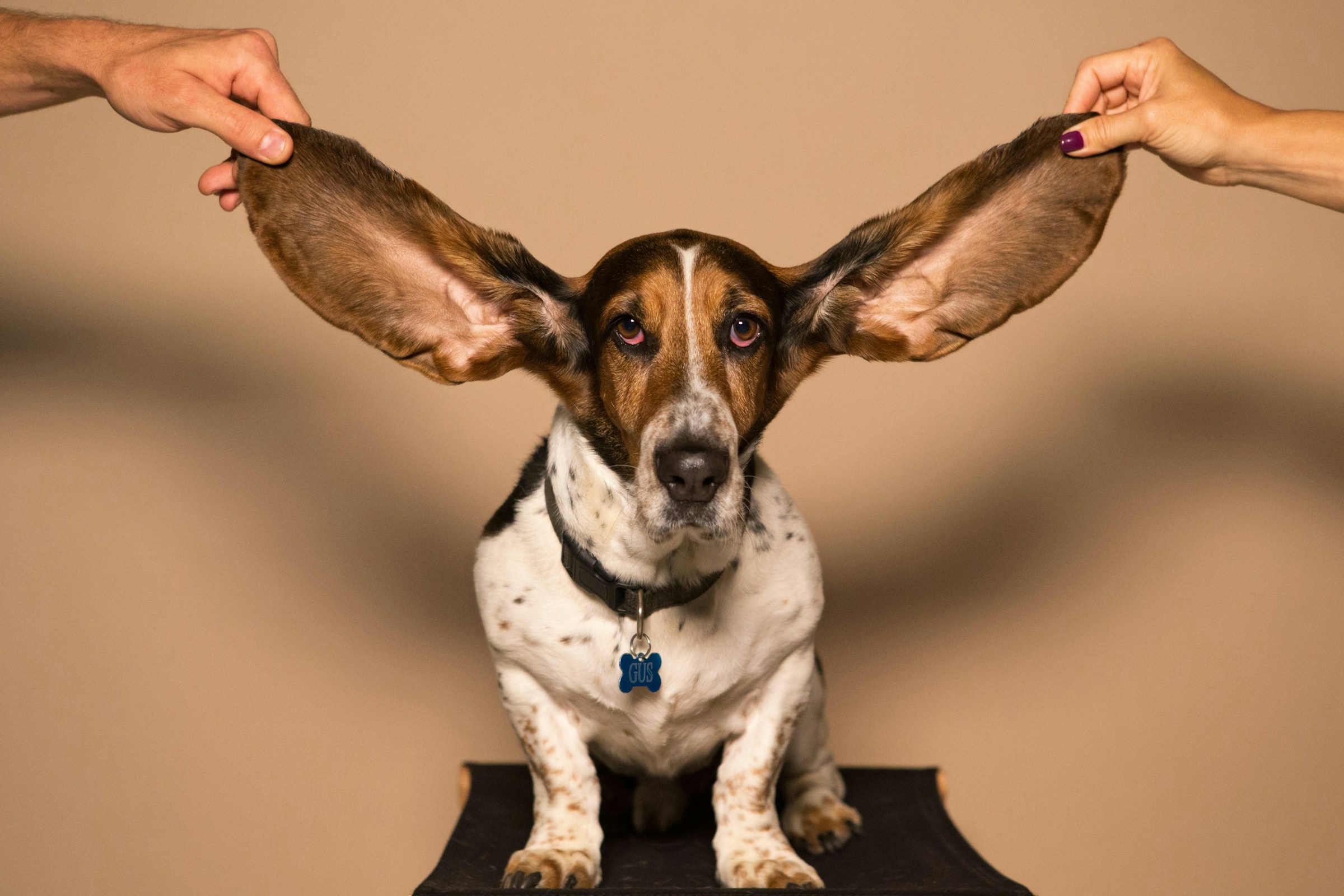
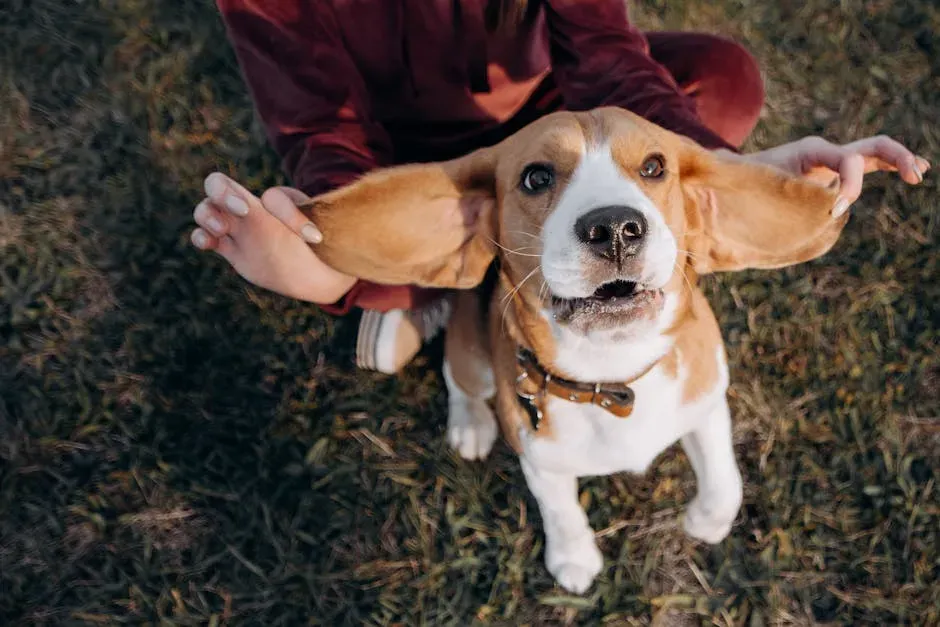
Humans have mostly fixed outer ears; we rely on turning our whole head to locate sounds. Dogs, on the other hand, have mobile pinnae – the flaps of their ears – that can rotate, tilt, and cup toward a noise, almost like a built-in sound radar system. Many dogs have over a dozen small muscles controlling each ear, allowing precise directional tuning.
This mobility dramatically improves their ability to pinpoint where a sound is coming from. When a dog suddenly pricks one ear, then the other, and then locks both on a particular direction, they are triangulating the source in real time. That is how they can go from “Did I hear something?” to “It came from that corner of the yard” in just a few seconds, even in the dark.
Even floppy-eared breeds still move the base of the ear and the muscles around the canal, gaining some of that directional advantage. Watching your dog’s ears can feel like reading subtitles for the soundtrack you are missing – each twitch is your only visible clue that something out of your range just happened.
#4 Dogs Use Minute Time Differences to Locate Sounds in 3D Space

Beyond the visible ear movement, there is a hidden layer of high-precision processing in the dog’s brain. When a sound reaches one ear a tiny fraction of a second before the other, the brain uses that delay to calculate direction. Dogs are extremely good at detecting these small time differences, allowing them to localize noises in three-dimensional space with impressive accuracy.
Imagine a mouse rustling in grass at dusk. Your dog not only hears the faint sound, but also figures out whether it is slightly left, slightly right, closer, or farther, often within a second or two. For hunting and working breeds, this skill was life-or-death in their ancestral roles: finding prey, following moving targets, or tracking subtle shifts in the environment.
- Dogs compare sound arrival times between the two ears.
- This lets them “map” sound sources even when they cannot see them.
- It is a built-in sound-based GPS they use constantly, indoors and outdoors.
#5 Dogs Hear Higher Overtones in Our Voices and Music

Human speech and music are not just single notes; they are full of stacked overtones and harmonics, many of which stretch into the higher frequencies that dogs can hear and we cannot. So when you speak to your dog, they are hearing layers of high-pitched texture riding above your words that are totally absent from your own experience of your voice.
This may help explain why dogs are so tuned into how we say things rather than what we say. They hear subtle shifts in tone, tension, and breathiness in the high ranges that fall outside our awareness. A phrase like “good boy” might sound basically identical to you each time, but to your dog, each repetition may carry a slightly different “color” based on stress, mood, and environment.
When music is playing, dogs experience extra shimmer and detail in the treble that we cannot hear. That does not mean they enjoy all music – some pieces, especially harsh, high-pitched electronic sounds, can actually be grating to them. What sounds pleasantly bright to us might feel like needles in their ears if the overtones land in their most sensitive range.
#6 Dog Hearing Has a Built-In Early Warning System for Storms

Many dog owners notice this strange pattern: the dog becomes restless or anxious well before a storm arrives, pacing, hiding, or whining long before thunder is audible to human ears. Part of that is their sensitivity to changes in air pressure and static, but another part is hearing distant thunder and low-frequency rumbles far earlier than we can.
Thunder is not a single boom; it is a complex wave of low and high frequencies. Dogs can detect both ends of this spectrum at greater distances and lower volumes than humans. By the time you hear that first roll of thunder, your dog may have been listening to it coming closer for quite a while, already bracing for the flashes and booms that usually follow.
- This early detection keeps dogs on edge for longer during storms.
- Sound-proofing a safe room and using consistent calming routines can help.
- What feels like “overreacting” is often a rational response to a louder, longer storm in their ears.
#7 Some Dogs Seem to Sense Seizures and Health Changes Through Sound and Subtle Signals

There are countless reports of dogs alerting people before seizures, blood sugar crashes, or other health events. Smell is a huge part of this, but tiny, involuntary sounds and changes in breathing may also fall into the picture. Dogs can hear extremely faint shifts in respiratory rhythm, muscle twitches, or vocal micro-sounds that humans do not consciously register.
In a quiet room, your dog may be tracking your breathing the way you might watch the flicker of a candle. Small changes in pace, depth, or pattern – barely noticeable to you – could be obvious audible flags to them. When combined with smell and body-language cues, their hearing gives them a multi-sensory early warning system that can feel almost psychic from a human perspective.
Trained medical alert dogs likely rely on a blended cocktail of signals, but the part that sits truly outside human hearing range – whispers of muscle movement, subtle throat sounds, slight irregularities in breath – is one we will never personally perceive. We only see the dog stand up, nudge, or bark in apparent anticipation of something we did not know was coming.
#8 Puppies Are Born Functionally Deaf and “Grow Into” Their Super Hearing

Here is a twist most people do not expect: puppies are born with ear canals that are essentially closed, and their hearing develops gradually over the first few weeks of life. They start off effectively deaf, then transition into the hyper-hearing adults we know. That means the legendary canine hearing range is not innate at birth but built up as structures mature.
As their ear canals open and the tiny bones and inner ear components finish developing, their hearing range expands dramatically, especially into those very high frequencies. By the time they are a few weeks old, they are already tracking sounds far beyond what we can hear. From there, the brain also learns to interpret and prioritize different sounds, like human voices, littermate calls, and environmental noises.
- Puppies go from near silence to a full canine hearing range in a surprisingly short time.
- Early sound experiences may help them learn which noises are normal and which are threatening.
- Positive sound exposure (gentle talking, calm music) can make a difference in confidence later.
#9 Different Breeds Hear the World Slightly Differently
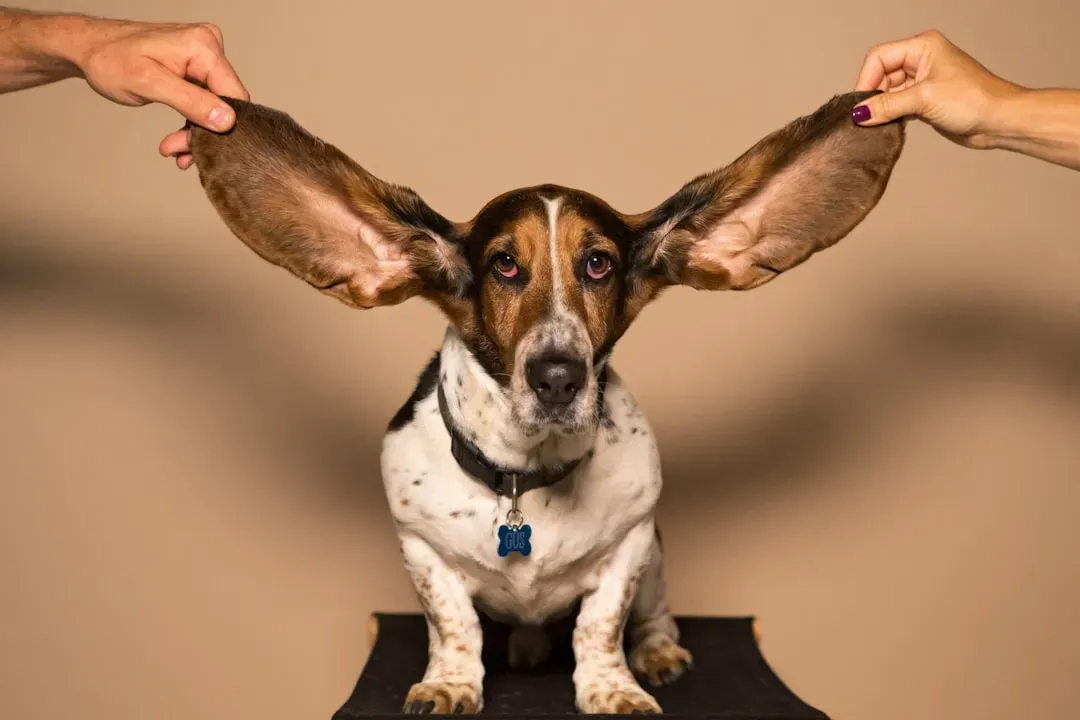
Although all healthy dogs hear better than humans in general, there are real differences between breeds and even individuals. Head shape, ear size, and ear position can all influence how sound enters the ear canal. Dogs with upright, pointed ears often get a boost in high-frequency collection, while dogs with large, mobile ears can cup sound like a built-in microphone.
Breeds that were developed for specific tasks, like herding or hunting, were often selected partly for sharp hearing and fast sound localization. A Border Collie waiting for a whistle across a windy field uses that extra high-frequency sensitivity and directional hearing like specialized work equipment. Meanwhile, some companion breeds may not have been selected as strongly for these traits, even though their hearing still far outstrips ours.
There is also a genetic side that can lead to hearing loss, especially in certain color patterns associated with deafness, like some all-white or merle dogs. What is fascinating is that even partially deaf dogs can sometimes compensate with other senses, leaning more on sight and smell. But in general, breed diversity means there is no single “dog hearing,” but a spectrum of super-hearing profiles with subtle variations.
#10 Loud Human Environments Can Be Painful in Dogs’ Extended Hearing Range

Because dogs hear quieter and higher sounds, a volume level that feels “lively” to you can be overwhelming to them. Busy city streets, construction noise, loud televisions, screaming children, and echoing indoor spaces can all be significantly more intense inside a dog’s ears than inside yours. Add high-pitched squeals, alarms, or phone notifications, and you get a constant, piercing soundtrack.
We also surround ourselves with devices that emit sounds in frequencies many adults no longer consciously hear: some lights, chargers, sensors, and security systems can produce high-frequency hums and squeals. Your dog, however, might be listening to those all day long. Behaviors like hiding in a quiet room, avoiding certain parts of the house, or acting “jumpy” for no obvious reason can sometimes be their way of escaping an invisible noise torture chamber.
- What is background noise to humans can be sharp and intrusive for dogs.
- Turning down volume, avoiding constant TV or music, and offering quiet spaces is not just kind – it is necessary.
- If a room feels slightly noisy to you, imagine it turned up a few extra clicks for your dog.
#11 Dog Hearing Changes With Age, But Not Always the Way You Think
Just like humans, many dogs lose some hearing as they get older, especially for higher pitches. Owners often notice that their senior dogs stop responding to soft sounds or distant calls. It is easy to assume the dog is being stubborn, but in many cases, the sounds are simply sliding below their sensitivity threshold or out of their upper range entirely.
But there is a twist here: even with age-related hearing loss, many older dogs still hear more of the world than we do, particularly in the mid-ranges. And they often become experts at reading vibration, routine, and visual cues to compensate. Some seniors will feel footsteps through the floor, catch the softest clink of a food bowl, or spot subtle body language that tells them everything they need to know.
This means a senior dog’s world does not necessarily go silent; it just changes. Lower and mid-range sounds stay, many high-pitched noises fade, and they lean more heavily on the other super-senses dogs already have, like smell and motion detection. Understanding this shift can help you be more patient and adjust how you communicate: more hand signals, clearer body language, and approaching from within their remaining hearing range.
#12 Dogs Live in a Layered Sound World We Will Never Fully Share

When you put all these findings together – extended high-frequency range, greater sensitivity, precise localization, extra overtones in voices and music, early storm warnings, and health-related signals – you end up with a simple truth: dogs occupy a sound reality that human beings can barely imagine. To them, our “quiet” house is buzzing with electronics, distant engines, and subtle bodily noises. Our “loud” party may feel like standing next to concert speakers you can never turn off.
Once you really absorb that, it becomes hard to shrug off “random” barking or anxiety as “bad behavior.” Your dog is responding to a world that is literally inaudible to you, with ears that have been shaped by evolution to notice faint risks, distant prey, and tiny social cues. You might miss the neighbor’s car door, the drip in the pipes, or the first crack of thunder, but your dog likely hears all of it and more.
- Dogs inhabit an acoustic landscape far richer than ours.
- What we consider silence is rarely truly silent for them.
- Respecting that invisible layer changes how we judge and care for them.
Conclusion: Hearing the World Through Their Ears (As Best We Can)

Here is my honest opinion: if more people understood how radically different dog hearing is, we would treat dogs – and their so-called “behavior problems” – very differently. A lot of what humans label as stubbornness, spookiness, or nuisance barking is really just a reasonable reaction to a soundscape we are too limited to notice. It is a bit like blaming someone for squinting in bright sunlight while you are wearing sunglasses.
We owe it to them to meet them halfway. That might mean turning down the TV, skipping the fireworks with them, giving them a quiet retreat from household chaos, and remembering that your “calm” might still be their sensory overload. It also means appreciating the incredible gift they bring us: an early-warning system, a deeper reading of our voices and moods, and a kind of constant, loyal vigilance we could never manage on our own.
We will never hear the hidden half of the soundtrack that shapes your dog’s life, but we can at least respect that it is there – and adjust our world just a bit to make room for theirs. The question is, now that you know what their ears are really dealing with, are you willing to start listening differently yourself?